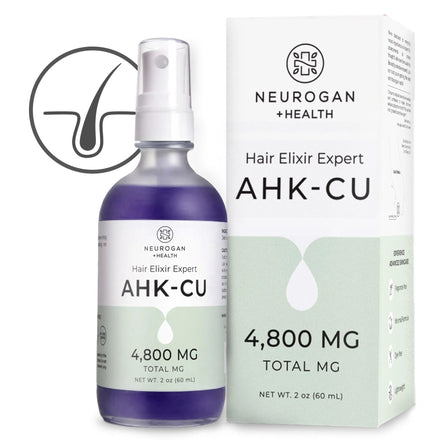
AHK-Cu has one of the cleanest side-effect profiles of any active used for hair: no hormonal effects, no systemic absorption of note at cosmetic doses, and no documented interactions with minoxidil, finasteride or microneedling. The side effects that do exist are local, mild and mostly avoidable. This is the practical list: what can happen, how often, why, and what to do about it.
If you want the clinical-evidence version of this question, read Is AHK-Cu safe?. This article is the one to read the night before you start.
The short version
| Effect | How common | What it is | What to do |
|---|---|---|---|
| Mild scalp tingling or warmth | Common in week 1 | Normal response to a copper complex on skin, fades within minutes | Nothing; it stops within days of regular use |
| Dryness or light flaking | Occasional | Water-based serum applied to an already dry scalp | Apply to a clean, slightly damp scalp; space out clarifying shampoos |
| Temporary increase in shedding | Uncommon, weeks 2–6 | Follicles shifting from resting to growth phase release the old hair first | Keep going; it is the same mechanism that precedes new growth (timeline) |
| Redness or itch that persists | Rare | Sensitivity to copper or contact irritation | Stop, patch test on the inner arm, restart every other day if the patch is clear |
| Blue-green tint on light hair or pillowcase | Rare, cosmetic only | Copper peptides are naturally blue; heavy application can transfer | Use the labelled dose, let it dry before lying down |
| Hormonal, sexual or mood side effects | Not reported | AHK-Cu does not act on androgens or 5-alpha reductase | Not applicable |
Why the list is short: what AHK-Cu does and does not touch
Most hair-loss side effects come from one of two mechanisms. Finasteride and dutasteride suppress DHT systemically, which is why they carry sexual and mood warnings. Minoxidil is a vasodilator absorbed through the scalp, which is why some users get headaches, palpitations or unwanted facial hair.
AHK-Cu does neither. It is a tripeptide (alanine-histidine-lysine) chelated to a copper ion, and in the research it acts locally on the follicle: increasing dermal papilla cell proliferation, raising VEGF output and lowering apoptosis in cultured human follicles.1 It does not bind androgen receptors and does not inhibit 5-alpha reductase, so the hormonal category of side effects does not apply. We go through the DHT question separately in Does AHK-Cu block DHT?
Copper itself is the ingredient people worry about. The amount in a daily dose of AHK-Cu Hair Elixir (roughly 0.5 mL of a 4,800 mg per 60 mL solution) is applied to the skin surface, where the peptide-bound copper is taken up locally rather than entering circulation in any meaningful quantity. Copper peptides have been used in cosmetics for over 30 years without a systemic toxicity signal at topical concentrations.2
Shedding: the side effect that scares people most
A minority of users notice more hairs in the drain between weeks 2 and 6. It is the same phenomenon reported with minoxidil, and the mechanism is the same: when a resting (telogen) follicle is pushed back into growth (anagen), it releases the old club hair to make room for the new shaft. The hair you lose was already dead; the follicle is not.
Three ways to tell treatment shedding from progression of hair loss:
- It starts within a few weeks of starting the serum, not months later.
- It stops on its own within 2 to 4 weeks.
- Fine, short regrowth follows in the same areas by weeks 8 to 12.
If shedding continues past week 8 or gets worse, that is not a serum effect and is worth a dermatologist visit. Full detail in how copper peptides extend the anagen phase.
Irritation and how to avoid it
A three-ingredient formula (AHK-Cu, GHK-Cu, purified water) removes the usual irritants: no alcohol, no propylene glycol, no fragrance, no preservative system that needs a low pH. That is deliberate; the formula rationale explains why. What remains is the copper complex itself, which a small number of people are sensitive to.
- Patch test if you have reactive skin: one spray on the inner forearm, wait 24 hours.
- Do not combine in the same application with ascorbic acid (vitamin C) products; the two interfere and the combination is more irritating than either alone. Timing guidance is in morning vs night routine.
- After microneedling, expect more tingling than usual on the first application; the channels are open. The microneedling protocol covers spacing.
- Open wounds, active scalp infection or severe seborrheic dermatitis: treat those first. A copper peptide on broken skin is not dangerous, but it will sting and you will not get a fair read on the serum.
Interactions
| Combined with | Known interaction | Practical note |
|---|---|---|
| Minoxidil | None documented; different mechanisms | Apply minoxidil first, let it dry, then the serum (stacking guide) |
| Finasteride / dutasteride (oral) | None; one is systemic, one is topical | No spacing needed |
| Ketoconazole shampoo | None | Shampoo, rinse well, dry, then apply |
| Vitamin C (ascorbic acid) topicals | Chemical interference, more irritation | Separate by 8 to 12 hours |
| Retinoids on the scalp | Additive irritation | Alternate nights |
| Pregnancy / breastfeeding | No data either way | Not studied; ask your clinician, as with any active |
Who should not use it
Anyone with a known copper allergy (rare, but it exists, usually discovered through jewellery or IUD reactions), anyone with Wilson's disease or another copper-metabolism disorder, and anyone whose hair loss is undiagnosed and sudden, which needs a cause found before any treatment. For everyone else, including women and people on hormonal hair-loss medication, the profile above is the complete known list. AHK-Cu for women covers the female-specific questions.
Frequently asked
Does AHK-Cu cause hair growth in unwanted places?
Not in reports. Unwanted facial or body hair is a minoxidil effect caused by systemic absorption; AHK-Cu is applied to the scalp and acts where it lands. Wash your hands after applying and you will not transfer it.
Can it make hair loss worse?
No mechanism for that exists, and the only "worse" people report is the temporary shedding described above, which resolves.
What happens if I stop?
Growth supported by the serum gradually returns to your baseline over several months, the same as with every topical. There is no rebound shedding beyond that.
Is it safe long term?
There is no long-term human trial of AHK-Cu specifically. What exists is decades of topical copper peptide use in cosmetics and a 2007 in-vitro study with no toxicity signal at hair-relevant concentrations.1,2 That is reassuring, not proof; we say so on the clinical studies page as well.
References
- Pyo HK, Yoo HG, Won CH, et al. The effect of tripeptide-copper complex on human hair growth in vitro. Arch Pharm Res. 2007;30(7):834-839. PMID: 17703734.
- Pickart L. The human tri-peptide GHK and tissue remodeling. J Biomater Sci Polym Ed. 2008;19(8):969-988. PMID: 18644225.
This article is educational and is not medical advice. Stop any topical that causes persistent irritation and speak to a clinician.