Hair length is not just about genetics. It's about time. Specifically, it's about how long your hair follicles remain in their active growth phase before they stop, rest, and cycle back. That window is called the anagen phase, and it's the single most important variable in how long, thick, and dense your hair can get.
Most people researching hair loss focus on what's visible: the hairline, the part, the density. But the visible changes come later. The root cause, in most cases, is the anagen phase getting progressively shorter with each cycle.
Follicles that once spent years in active growth start spending months. The strands they produce get thinner and shorter. Eventually, the growth phase becomes too brief to produce much hair at all.
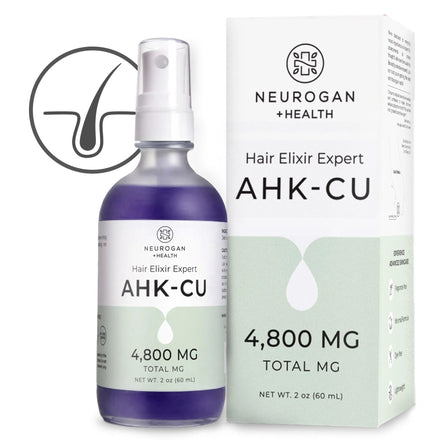
Copper peptides, and AHK-Cu (Copper Tripeptide-3) in particular, have been studied for their potential to extend the anagen phase through three distinct cellular mechanisms.
What Is the Hair Growth Cycle?
Every hair follicle on your scalp operates on its own independent schedule, cycling through three phases repeatedly over a lifetime: anagen (active growth), catagen (transition), and telogen (rest). A healthy follicle repeats this cycle approximately 25 to 30 times before it may retire permanently.
On a healthy scalp, roughly 85 to 90 percent of follicles are in the anagen phase at any given time. About one to two percent are in catagen, and ten to fifteen percent are in telogen. Those ratios are critical because they keep the scalp looking full — at any given moment, the vast majority of follicles are actively producing hair.
When that balance shifts, whether through hormonal effects, aging, stress, or nutritional deficiency, visible thinning follows. It's not necessarily that follicles are dying. More often, it's that fewer of them are in anagen at any one time, or that the anagen phase is shorter, so each strand produced is thinner and briefer. The number you see in the mirror is the downstream result of a ratio that shifted months earlier.
The Anagen Phase Explained: Where Hair Actually Grows
The anagen phase is the active growth phase of the hair cycle. In healthy scalp follicles, it lasts anywhere from two to seven years, with the upper end of that range largely determined by genetics. During anagen, two cell types do most of the work.
Dermal papilla cells (DPCs) are specialized fibroblasts at the base of the follicle. They function as the growth signal generators: reading the body's hormonal and nutritional environment and transmitting instructions to the rest of the follicle. When dermal papilla cells are healthy and active, the anagen phase progresses. When DPC populations decline or DPC activity weakens, the phase shortens.
Matrix cells are the rapidly dividing cells just above the dermal papilla. Their division rate during anagen is among the fastest of any cell type in the human body. Each division pushes the developing hair strand upward through the follicle and out through the scalp. The longer the follicle stays in anagen, the more matrix cell divisions occur, and the longer and thicker the resulting strand.
Strand thickness and length are both direct functions of anagen duration. A follicle in anagen for six years will produce a substantially longer, fuller strand than the same follicle in anagen for six months. This is why extending anagen is one of the more targeted approaches to improving hair density and length, and why the mechanisms by which copper peptides may achieve this are worth investigating.
Catagen and Telogen: What Happens When Growth Stops
When the anagen phase ends, the follicle enters catagen, a brief transition phase lasting roughly two to three weeks. During catagen, the follicle physically shrinks to about one-sixth of its anagen size. It detaches from its blood supply, cutting off the nutrients and oxygen that sustained matrix cell division. Active growth ceases.
After catagen comes telogen, the resting phase, which lasts approximately three months. During telogen, the hair strand remains anchored in the follicle but no longer grows. At the end of telogen, the strand is shed, and if the follicle is healthy, a new anagen phase begins, restarting the cycle.
Premature entry into catagen and telogen is the cellular mechanism behind most forms of hair loss. In androgenetic alopecia, the most common pattern, DHT (dihydrotestosterone) sensitivity causes dermal papilla cells to progressively lose function. As DPC activity declines, the signal that sustains anagen weakens, and the follicle exits the growth phase earlier than it should. In telogen effluvium, an external trigger — such as significant stress, illness, or hormonal change — pushes a large proportion of follicles out of anagen and into telogen simultaneously, producing the characteristic diffuse shedding that follows roughly three months after the triggering event.
In both cases, the problem is the same at the molecular level: the anagen phase ends too soon.
Why Anagen Gets Shorter with Age and Hair Loss
In androgenetic alopecia, DHT is the primary driver of anagen shortening.
DHT binds to receptors in genetically susceptible dermal papilla cells and gradually compromises their function. With each hair cycle, the affected DPCs support a slightly shorter anagen phase. A follicle that once spent five or six years growing hair may spend only two, then one, then a few months per cycle.
This progressive shortening is the cellular engine behind follicle miniaturization. Each shorter anagen produces a thinner, shorter strand, because the matrix cells have less time to divide. The follicle itself physically shrinks as DPC volume decreases. What was once a terminal hair follicle producing thick, pigmented strands becomes a vellus follicle producing fine, unpigmented ones. Eventually, if the process continues, the anagen phase becomes too short to produce anything visible.
Age-related anagen shortening follows a similar pattern but through different mechanisms: slower cell renewal, reduced scalp circulation, and accumulated oxidative stress, rather than DHT sensitivity specifically. The outcome is similar: shorter cycles, thinner strands, a gradual reduction in density.
This clarifies why the most useful interventions are those that act on the anagen phase directly, either by removing what's shortening it (blocking DHT) or by reinforcing what sustains it (supporting dermal papilla cell health and delaying the catagen transition signal). Copper peptides work on the latter.
How Copper Peptides Extend the Anagen Phase
AHK-Cu (Copper Tripeptide-3) is a synthetic copper peptide specifically engineered to interact with hair follicle biology. GHK-Cu (Copper Tripeptide-1) is its naturally occurring counterpart, primarily associated with skin repair and anti-inflammatory activity, with indirect benefits to the scalp environment. Together, they form the copper peptide class of bioactive compounds — amino acid chains bonded to a copper ion — that are studied for their effects at the follicle level.
The evidence for AHK-Cu's effect on anagen duration comes primarily from a 2007 study by Pyo et al. at Seoul National University, which found statistically significant hair follicle elongation (p < 0.001) in cultured human follicles treated with AHK-Cu [1]. Follicle elongation during the culture period reflects sustained anagen activity. The research points to three mechanisms through which this effect appears to occur.
Mechanism 1: Dermal Papilla Cell Proliferation
The most direct mechanism is AHK-Cu's effect on dermal papilla cells, which generate and sustain the growth signal. The Pyo 2007 study found statistically significant DPC proliferation in treated cultures (p < 0.001) [1].
More active DPCs mean a stronger and more sustained growth signal reaching the matrix cells above them. The anagen phase continues as long as that signal is strong enough to maintain matrix cell division. This is the upstream mechanism — extending anagen requires sustaining the growth signal at its source, and the dermal papilla is that source.
Mechanism 2: TGF-β1 Reduction
TGF-beta-1 (transforming growth factor beta-1) is the cytokine that acts as the termination signal for the anagen phase. When TGF-beta-1 levels rise within and around the follicle, the dermal papilla interprets this as a signal to stop growing and initiates the catagen transition.
Research by Lee et al. in 2016 found that AHK-Cu treatment was associated with decreased TGF-beta-1 secretion in dermal fibroblasts [2]. If TGF-beta-1 stays lower for longer, the stop-growing signal arrives later, and the follicle remains in anagen beyond the point at which it would otherwise have exited. That delay, even measured in weeks or months, translates to more strand growth per cycle and more follicles simultaneously in active growth on the scalp.
Mechanism 3: DPC Apoptosis Inhibition
The third mechanism involves keeping dermal papilla cells alive. In the context of hair follicles, excess DPC apoptosis means the cell population sustaining the growth signal shrinks. Fewer DPCs, weaker signal, earlier exit from anagen.
The Pyo 2007 study measured this directly. AHK-Cu treatment was associated with elevation of the Bcl-2/Bax survival ratio in DPCs (p < 0.05), a 42.7% reduction in cleaved caspase-3, and a 77.5% reduction in cleaved PARP — all markers of reduced apoptotic activity [1]. DPCs that survive longer sustain the anagen phase longer.
The Role of VEGF in Sustaining Anagen
Extending the anagen phase creates a demand problem. An active follicle in the middle of anagen is metabolically expensive: matrix cells are dividing rapidly, the follicle is growing physically, and the dermal papilla requires a steady nutrient supply. All of that depends on blood.
VEGF (vascular endothelial growth factor) is a signaling protein that triggers the formation of new blood vessels. Research has associated copper peptide treatment with increased VEGF production in fibroblasts [2]. New capillary formation around active follicles means better oxygen and nutrient delivery to the dermal papilla and the matrix cells it supports — better-supplied follicles are better equipped to sustain anagen.
How Does This Compare to Minoxidil?
Minoxidil works on a related vascular mechanism via a different route: it's a vasodilator, widening existing blood vessels to increase blood flow to the scalp. Copper peptides, by upregulating VEGF, appear to promote new vessel formation rather than simply widening existing ones. The two approaches aren't mutually exclusive, which is part of why some practitioners use both.
Anagen Extension vs. DHT Blocking: Two Different Approaches
The most common hair loss treatments work by blocking DHT rather than directly targeting anagen duration. It's worth being clear about how these approaches differ and where copper peptides fit.
| Approach | How It Affects Anagen | Mechanism | Hormonal? |
|---|---|---|---|
| AHK-Cu | Observed to extend current anagen via DPC proliferation, TGF-β1 reduction, apoptosis inhibition | Follicle nourishment pathway | No |
| GHK-Cu | Supports anagen indirectly via scalp repair, collagen synthesis, anti-inflammatory activity | Tissue repair pathway | No |
| Finasteride | Protects future anagen cycles by blocking DHT that progressively shortens them | DHT blocking (systemic) | Yes |
| Dutasteride | Broader DHT blockade; protects future anagen cycles more aggressively | Dual DHT blocking (systemic) | Yes |
| Minoxidil | Supports anagen indirectly by improving scalp blood flow via vasodilation | Vasodilation; possible potassium channel activity | No |
Finasteride and dutasteride work by blocking DHT production, which removes the hormonal driver that progressively shortens future anagen cycles. They're protecting the cycle length that would otherwise deteriorate — not actively prolonging the current cycle. These approaches are complementary rather than competing. Someone using finasteride to slow DHT-driven miniaturization while using AHK-Cu to support DPC health and TGF-beta-1 levels is addressing the problem from two directions simultaneously.
Copper peptides offer the non-hormonal path, which matters for women and for men who want to avoid the hormonal side effect profile associated with DHT-blocking medications.
What Longer Anagen Means for Your Hair
Longer anagen means longer strands. If a follicle that was previously cycling through six-month anagen phases extends to twelve-month phases, the strand it produces is roughly twice as long before shedding. Accumulated across many follicles, that change becomes visible as greater length potential and overall density.
Strand diameter is also influenced by anagen duration, because a follicle in active anagen is producing more matrix cell divisions per unit time, contributing to a thicker strand cross-section. This is why hair compromised by miniaturization tends to be both shorter and finer — both are expressions of shortened anagen.
More follicles in anagen simultaneously means more actively growing hairs on the scalp at any given moment. Even without any change in the number of follicles, improving the ratio of anagen to telogen follicles increases visible density.
Reduced shedding is often the first noticeable change — telogen hairs are the ones that shed, and anagen hairs stay in place. If more follicles remain in anagen longer, fewer enter telogen per week, and the daily shed count decreases. This is typically the earliest sign that a follicle-targeting treatment is having an effect, and it tends to appear within four to eight weeks of consistent use.
Visible new growth generally appears around the two-to-three-month mark. Changes in overall density that show up clearly in photographs generally require five to six months of consistent daily use. Hair cycling is slow, and the biology doesn't skip steps regardless of what's being applied.
The Case for Working on Anagen Duration
Most hair loss treatments focus on blocking the hormonal driver or improving scalp blood flow. Both are legitimate approaches with clinical evidence backing them. But they don't directly address the anagen phase itself — the window during which hair actually grows and whose length determines how much of it you have.
Copper peptides, and AHK-Cu specifically, have a more targeted relationship to anagen biology than most topical ingredients. The DPC proliferation findings from Pyo 2007, the TGF-beta-1 reduction and VEGF upregulation from Lee 2016, and the anti-apoptotic markers across both studies all point toward the same outcome: follicles that stay in anagen longer, with more active DPC support and a delayed exit signal [1] [2]. The evidence is preclinical and small-scale and we're still waiting for large randomized trials, so keep your expectations within reason.
That said, the risk profile of topical copper peptides is low, the mechanistic rationale is sound, and for someone serious about hair health over the long term, supporting anagen duration is a reasonable goal. The follicle nourishment pathway that copper peptides work through is unique enough from other approaches that it adds something, rather than duplicating what minoxidil or finasteride already cover.
References
- Pyo, H. K., Yoo, H. G., Won, C. H., Lee, S. H., Kang, Y. J., Eun, H. C., Cho, K. H., & Kim, K. H. (2007). The effect of tripeptide-copper complex on human hair growth in vitro. Archives of Pharmacal Research, 30(7), 834–839. https://pubmed.ncbi.nlm.nih.gov/17703734/
- Lee, W. J., Lee, S. M., Choe, Y. B., & Ahn, K. J. (2016). Effects of copper-tripeptide on hair growth in a mouse model and in human dermal papilla cells. Annals of Dermatology, 28(4), 413–419. https://pubmed.ncbi.nlm.nih.gov/27489425/