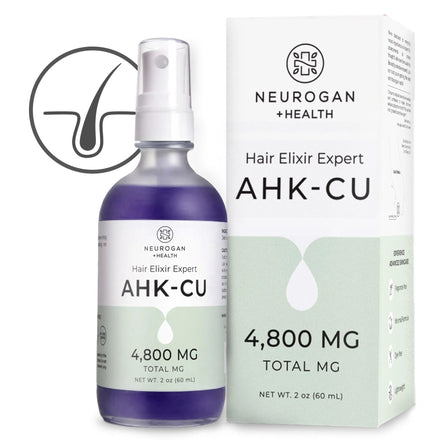
Yes, you can use AHK-Cu with minoxidil. There are no known interactions between them, and combining the two covers more of the biology of hair loss than either one does alone.
The longer answer is worth understanding, because stacking hair loss treatments to target different biological pathways works best when you know what each one is actually doing and why they complement each other.
what is AHK-Cu? Understanding Copper Tripeptide-3 for Hair Growth
AHK-Cu (L-alanyl-L-histidyl-L-lysine copper) is a synthetic copper tripeptide composed of alanine, histidine, and lysine chelated to a copper ion.It was first studied specifically for hair growth in a 2007 paper from Seoul National University, which found statistically significant hair follicle elongation and dermal papilla cell proliferation in cultured human follicles treated with the compound [1].
A 2016 randomized study of 45 patients found 52-71 new hairs at the six-month mark with copper peptide treatment [2].
AHK-Cu is not FDA-approved for hair loss and cannot legally be marketed as a hair loss treatment.How Minoxidil Works: The FDA-Approved Gold Standard
Minoxidil is the most widely used topical hair loss treatment in the world and the only topical with full FDA approval for androgenetic alopecia. It primarily acts as a vasodilator, widening blood vessels in the scalp by opening potassium channels in smooth muscle cells.What minoxidil does not do:
- It does not block DHT, the hormone responsible for follicular miniaturization.
- It doesn't directly stimulate dermal papilla cell proliferation.
- It doesn't build new blood vessels.
Minoxidil's evidence base is decades deep, and its efficacy in slowing and partially reversing androgenetic alopecia is well-established [3].
AHK-Cu vs GHK-Cu: What's the Difference for Hair Loss?
| Compound | AHK-Cu (Copper Tripeptide-3) | GHK-Cu (copper tripeptide-1) |
|---|---|---|
| Origin | Synthetic, engineered for hair follicle targeting | Naturally occurring in human plasma |
| First studied | 2007, Seoul National University | 1973, Dr. Loren Pickart |
| Primary research findings | Hair follicle stimulation, anagen extension | Skin repair, collagen synthesis, anti-inflammatory |
| Best used for hair | Direct follicle cell stimulation | Scalp environment maintenance |
How AHK-Cu and Minoxidil Target Different Biological Pathways
| Mechanism | AHK-Cu | Minoxidil |
|---|---|---|
| Primary action | Stimulates dermal papilla cell proliferation, inhibits follicle cell apoptosis | Vasodilation via potassium channel opening |
| VEGF | Upregulates VEGF production in fibroblasts (new vessel formation) | Indirect blood flow improvement |
| Anagen extension | Via TGF-beta-1 reduction | Via potassium channel mechanism |
| Anti-apoptotic | Yes: ~43% caspase-3 reduction, ~78% PARP reduction | Not established |
| FDA approval for hair | No (cosmetic ingredient) | Yes (OTC topical) |
Minoxidil widens the existing pipes that supply blood to the follicles. AHK-Cu works at the follicle cell level, stimulating cells that control growth signaling. One is systemic and vascular — the other is cellular and regenerative. They don't duplicate each other.
Application Order
Apply minoxidil first, particularly if using the liquid formulation. Let it dry fully, typically five to ten minutes, before applying anything over it. Then apply your AHK-Cu serum or spray to the same scalp areas.| Treatment | Frequency | Time of Day | Notes |
|---|---|---|---|
| Minoxidil (standard topical) | Twice daily | AM and PM | 1 mL per application is standard |
| Minoxidil (foam) | Once or twice daily | AM and/or PM | Half a capful per application |
| AHK-Cu serum/spray | Once or twice daily | AM and/or PM | Apply after minoxidil has dried |
What Not to Apply at the Same Time
The ingredient to separate from AHK-Cu is vitamin C in ascorbic acid form. Minoxidil is pH-neutral relative to this concern and is not an issue.Combination Evidence
A 2013 study comparing microneedling plus minoxidil to minoxidil alone found the combination group grew about 91 new hairs vs. 22 in the minoxidil-only group [5]. This shows that improving follicle cell health alongside minoxidil can produce much better results.Other Treatments to Consider Stacking
finasteride
For men with pattern hair loss, finasteride plus minoxidil is the strongest evidence-backed non-surgical protocol available. Adding AHK-Cu alongside both adds the cellular support layer that neither pharmaceutical addresses.Microneedling
Applied immediately after a needling session while channels are open, AHK-Cu can reach dermal papilla cells at much higher concentrations than standard topical application.Low-Level Laser Therapy (LLLT)
LLLT devices use specific wavelengths of red light to stimulate mitochondrial activity in follicle cells. Adding it to a minoxidil plus AHK-Cu stack adds a third independent mechanism [7].Safety and Side Effects
AHK-Cu
No significant side effects have been documented at topical scalp concentrations. No hormonal effects or systemic changes. We recommend patch testing before full scalp application if you have sensitive skin.Minoxidil
The most common side effect is an initial shedding phase in the first four to eight weeks. Scalp irritation occurs in a subset of users, more commonly with liquid formulations.Expected Timeline
| Timeline | What You Might Notice | What This Reflects |
|---|---|---|
| Weeks 1-4 | Possible initial shedding | Expected minoxidil effect |
| Weeks 4-8 | Shedding slows, scalp condition may improve | Anti-inflammatory and anti-apoptotic effects |
| Months 2-3 | Fine new hairs appearing | Follicles re-entering anagen |
| Months 4-6 | Visible density improvements | Cumulative VEGF and collagen improvements |
| 6 months+ | Full picture of individual response | Assessment point for protocol decisions |
Six months of consistent daily use of both is the minimum evaluation window.
References
- Pyo, H. K., et al. (2007). The effect of tripeptide-copper complex on human hair growth in vitro. Archives of pharmacal research, 30(7), 834-839.
- Lee, W. J., et al. (2016). Efficacy of a complex of 5-aminolevulinic acid and glycyl-histidyl-lysine peptide on hair growth. Annals of dermatology, 28(4), 438-443.
- Rietschel, R. L., & Duncan, S. H. (1987). Safety and efficacy of topical minoxidil. Journal of the American Academy of Dermatology, 16(3), 677-685.
- Kumar, M. K., et al. (2018). A randomized controlled study to determine the efficacy of topical minoxidil plus microneedling versus topical minoxidil alone. Journal of cutaneous and aesthetic surgery, 11(4), 211-216.
- Avci, P., et al. (2014). Low-level laser therapy for treatment of hair loss. Lasers in surgery and medicine, 46(2), 144-151.