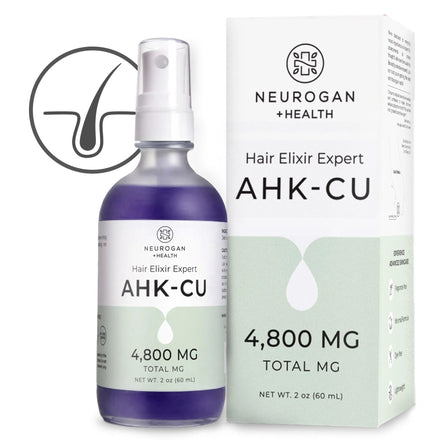
AHK-Cu is not designed specifically for women — it's a copper peptide studied for hair follicle stimulation in general. But women have particular reasons to be interested in it, most of them related to what it isn't: not hormonal, not a DHT blocker, and not contraindicated in pregnancy or fertility contexts in the way that finasteride is.
Understanding Women's Hair Loss: Types and Causes
Female Pattern Hair Loss (FPHL / androgenetic alopecia)
Female pattern hair loss is the most common form of hair loss in women. Unlike the receding M-shaped hairline in men, FPHL typically presents as diffuse thinning over the crown and top of the scalp, with the frontal hairline often preserved.Female AGA is mediated partly by androgens — specifically DHT acting on follicles with androgen receptors — but estrogen decline (particularly around perimenopause and menopause) and other factors play a role that is less understood than the male equivalent.
Telogen Effluvium
Telogen effluvium (TE) is a temporary, often dramatic shedding caused by a systemic stressor: illness, childbirth, surgery, crash dieting, thyroid changes, or severe psychological stress. The hair follicles shift prematurely from the growth phase (anagen) to the resting phase (telogen), then shed in bulk weeks to months later.Other Forms of Hair Loss in Women
- Alopecia areata (autoimmune; patchy)
- Traction alopecia (mechanical; from hairstyles)
- Frontal fibrosing alopecia (scarring; primarily postmenopausal women)
- Central centrifugal cicatricial alopecia (CCCA; scarring; primarily Black women)
what is AHK-Cu? How It Works for Hair Loss
AHK-Cu (copper tripeptide-3, also called Copper Tripeptide-3) is a synthetic tripeptide chelated to copper. It differs from GHK-Cu by one amino acid at the N-terminal position.Key mechanisms for hair:
- Stimulates dermal papilla cell proliferation — the cells that control hair follicle growth cycling
- Extends the anagen (growth) phase by reducing TGF-beta-1 signaling
- Upregulates VEGF expression — increasing vascular supply to the follicle
- Reduces apoptosis of follicle cells by approximately 43-78% in cell studies [1]
is AHK-Cu safe for Women? Safety Profile and Considerations
AHK-Cu is a topical cosmetic ingredient with no established systemic absorption at standard concentrations. No hormonal effects have been documented. No drug interactions at cosmetic doses. Not categorized as a contraindicated ingredient in pregnancy, though as with any topical product, a conservative approach (consult your healthcare provider) is appropriate.What AHK-Cu Is Not
- Not FDA-approved for hair loss treatment (it's a cosmetic ingredient)
- Not a DHT blocker
- Not a substitute for proven medical treatments in moderate-to-severe FPHL
clinical evidence for Copper Peptides in Women's Hair Loss
The most applicable clinical study is Lee et al. (2016), a randomized, controlled trial of 45 patients treated with a copper peptide complex for six months. The study found 52-71 new hairs in treated areas at the six-month mark [2]. Both male and female subjects were included.This is small data. It is not a large, multisite trial. The appropriate framing is: there is early human evidence suggesting AHK-Cu can stimulate hair growth when applied topically for six months, with an acceptable safety profile. It does not replace finasteride or minoxidil in the evidence hierarchy.
AHK-Cu vs Minoxidil for Women's Hair Loss
Minoxidil at 2% is FDA-approved for women with androgenetic alopecia. It has decades of controlled trial data and is recommended as first-line treatment.| AHK-Cu | Minoxidil (Topical) | |
|---|---|---|
| FDA-approved for women? | No (cosmetic) | Yes (2% OTC) |
| Evidence strength | Small trials, cell data | Decades of controlled trials |
| Hormonal effects | None | None |
| Mechanism | Follicle cell stimulation, VEGF, anti-apoptotic | Vasodilation, anagen extension |
| Initial shedding? | Not reported | Possible in first 4-8 weeks |
| Stops working when stopped? | Gradual decline | Hair loss returns within months |
| Compatible to use together? | Yes | Yes |
Why Women May Be Particularly Interested in Copper Peptides
For Women Who Can't Use Hormonal Treatments
Finasteride is generally contraindicated for women of childbearing age due to teratogenicity (it can cause birth defects in male fetuses). Dutasteride carries similar concerns. Spironolactone requires monitoring.AHK-Cu, as a non-hormonal, topical ingredient, is an option available to:
- Women trying to conceive
- Women who wish to avoid hormonal treatments for personal reasons
- Women for whom hormonal treatments are medically contraindicated
For postpartum hair loss
Postpartum hair loss (postpartum telogen effluvium) is extremely common — affecting up to 50% of new mothers — and typically self-resolves within three to six months. Copper peptide serums are a reasonable supportive option during this period, as they are non-hormonal, have a low risk profile, and support scalp tissue health.See the dedicated article on postpartum hair loss for more detail.
For Perimenopausal and Postmenopausal Women
The estrogen decline of perimenopause and menopause affects follicle cycling, scalp collagen, and skin laxity. GHK-Cu specifically has a documented role in collagen synthesis and antioxidant protection, which addresses some of these structural changes. AHK-Cu's follicle cell stimulation is relevant to the concurrent increase in AGA risk.how to use AHK-Cu for Women's Hair Loss
The application protocol for women is the same as for anyone using the product: apply to a clean, dry scalp, massage in, leave on. Consistency over months matters more than any other variable.For FPHL, focus application on the crown and midscalp. Parting the hair into sections helps ensure the serum reaches the scalp.
The evaluation window is six months minimum. Fine new hairs in previously thinning areas are typically the first sign of a response.
What to Combine AHK-Cu With for Women's Hair Loss
| Treatment | Notes |
|---|---|
| Minoxidil 2% topical | First-line; compatible and complementary |
| Minoxidil 5% topical | Used off-label by some women; discuss with dermatologist |
| Oral minoxidil | Low-dose oral minoxidil is increasingly used; no known conflict with AHK-Cu |
| Spironolactone | Hormonal; for women with documented high androgens; not compatible for some |
| GHK-Cu | Complementary to AHK-Cu; many formulas include both |
| Biotin/other supplements | No evidence of interaction; evidence for biotin is only for documented deficiency |
Realistic Expectations
AHK-Cu is a slow treatment. Results are measured in months, not weeks. The six-month mark is when most users see meaningful changes, if they respond. Some don't, or respond only minimally. There are no reliable predictors of who will respond.Women with diffuse FPHL are likely better candidates than women with severe, long-standing hair loss. For scarring alopecias, copper peptides are not appropriate first-line treatment.
The Bottom Line
AHK-Cu is a non-hormonal, topical hair loss support option with early clinical evidence and a low risk profile. For women who want to complement or substitute minoxidil — particularly those who cannot use DHT-blocking medications — it's a practical choice with a favorable safety profile.Use it consistently, evaluate at six months, and pair it with evidence-based treatments when possible.
References
- Pyo, H. K., et al. (2007). The effect of tripeptide-copper complex on human hair growth in vitro. Archives of pharmacal research, 30(7), 834-839.
- Lee, W. J., et al. (2016). Efficacy of a complex of 5-aminolevulinic acid and glycyl-histidyl-lysine peptide on hair growth. Annals of dermatology, 28(4), 438-443.