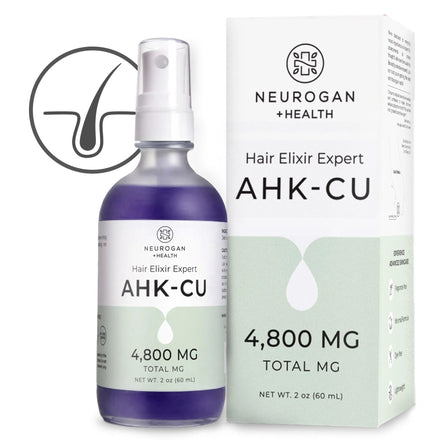
"Peptides for hair growth" covers everything from a copper tripeptide with a follicle study behind it to injectable research chemicals with none. This guide ranks the peptides people actually search for by the quality of their hair-specific evidence, says what each one does, and is honest about which ones are marketing. One note on method: we make an AHK-Cu + GHK-Cu serum, so read the AHK-Cu entry with that in mind and check the references yourself.
How we ranked them
Three questions, in order. Is there a hair-specific study, not a skin or wound study? Was it in humans, in human tissue, or in rodents? Does the peptide reach the follicle by the route it is sold in? A peptide with a human trial outranks one with a dish study; a dish study on human follicles outranks a mouse study; and any study outranks a forum protocol.
Tier 1: hair-specific evidence in human tissue or humans
1. AHK-Cu (copper tripeptide-3)
Route: topical. Evidence: human dermal papilla cells and whole human follicles in vitro (Pyo 2007): increased papilla proliferation, higher VEGF, less apoptosis, longer follicle growth.1 Verdict: the only copper peptide whose foundational study was designed around hair. No human trial yet. Full profile in What is AHK-Cu?; our serum is here.
2. GHK-Cu (copper tripeptide-1)
Route: topical. Evidence: broad wound-healing and remodelling literature (Pickart 2008)2; the one randomised human hair trial used a 5-aminolevulinic acid + GHK complex and reported more new hairs than placebo over 6 months.3 Verdict: the best-studied copper peptide overall, with hair evidence that is real but indirect (the trial compound was a complex, not GHK-Cu alone). Anti-inflammatory and antioxidant effects are relevant in DHT-affected scalps. Detail in What is GHK-Cu? and AHK-Cu vs GHK-Cu.
3. Biotinoyl tripeptide-1 (Procapil's peptide component)
Route: topical, always in a blend with apigenin and oleanolic acid. Evidence: manufacturer-sponsored human studies on the blend showing improved anagen/telogen ratio; little independent replication. Verdict: plausible, commercially common, but you cannot separate the peptide's contribution from the blend's.
Tier 2: relevant mechanism, thin hair evidence
4. Acetyl tetrapeptide-3 (Capixyl's peptide component)
Route: topical, blended with red clover extract. Evidence: a small sponsored human study on the blend reporting density gains versus minoxidil over 4 months. Verdict: same caveat as Procapil: blend data, not peptide data.
5. Palmitoyl pentapeptide-4 and other "signal" peptides
Route: topical. Evidence: skin collagen studies; essentially none for hair. Verdict: appears in hair serums because it is already in skincare supply chains, not because of follicle data.
Tier 3: injectable research peptides
BPC-157, TB-500, GHK-Cu injections and now AHK-Cu injections circulate on peptide forums with "hair growth" in the claims. The common thread: none has a human hair study by injection, the dosing is borrowed from unrelated protocols, and the product is unsterile research powder. GHK-Cu and AHK-Cu at least have topical follicle data, which is the route to use them. We cover the injection question specifically in Is AHK-Cu injectable?
What about collagen peptides?
Oral collagen peptides are a different category: hydrolysed protein taken as a supplement. Evidence for hair is limited to small studies on hair thickness and self-reported quality; they do not act on the follicle growth cycle the way topical copper peptides do. Reasonable as nutrition, not a hair-loss treatment.
Summary table
| Peptide | Route | Best hair evidence | Hormonal effects | Our take |
|---|---|---|---|---|
| AHK-Cu | Topical | Human follicles in vitro (2007) | None | Strongest hair-specific mechanism; needs a human trial |
| GHK-Cu | Topical | Human RCT of a GHK complex (2016) | None | Best overall literature; pair with AHK-Cu |
| Biotinoyl tripeptide-1 | Topical blend | Sponsored human studies on the blend | None | Plausible, unseparated |
| Acetyl tetrapeptide-3 | Topical blend | Small sponsored human study on the blend | None | Plausible, unseparated |
| Signal peptides (pal-KTTKS etc.) | Topical | Skin only | None | Skip for hair |
| Injectable peptides | Injection | None for hair | Varies | Avoid |
| Collagen peptides | Oral | Small thickness studies | None | Nutrition, not treatment |
How peptides compare with the drugs
Minoxidil and finasteride still have the strongest human evidence for androgenetic alopecia, and we say so in AHK-Cu vs minoxidil and AHK-Cu vs finasteride. The case for copper peptides is different: no hormonal side effects, no dependency rebound of the minoxidil kind, and a mechanism (papilla proliferation, circulation, anti-inflammation) that complements rather than duplicates the drugs. Most people who do well use them together; the stacking guide explains the order.
Choosing a peptide serum
- Look for the INCI names: Copper Tripeptide-3 (AHK-Cu) and Copper Tripeptide-1 (GHK-Cu). "Copper peptides" alone usually means GHK-Cu only.
- Check the concentration is stated in mg, not hidden in a "complex".
- Ask for a certificate of analysis showing purity; copper peptides degrade if made badly.
- Fewer excipients is better for a daily scalp product; the three-ingredient argument is here.
- Commit to 12 weeks before judging; the timeline explains why.
Our product comparison applies these criteria across the market.
References
- Pyo HK, Yoo HG, Won CH, et al. The effect of tripeptide-copper complex on human hair growth in vitro. Arch Pharm Res. 2007;30(7):834-839. PMID: 17703734.
- Pickart L. The human tri-peptide GHK and tissue remodeling. J Biomater Sci Polym Ed. 2008;19(8):969-988. PMID: 18644225.
- Lee WJ, et al. Efficacy of a complex of 5-aminolevulinic acid and glycyl-histidyl-lysine peptide on hair growth. Ann Dermatol. 2016;28(4):438-443. PMID: 27489425.
Educational content, not medical advice.