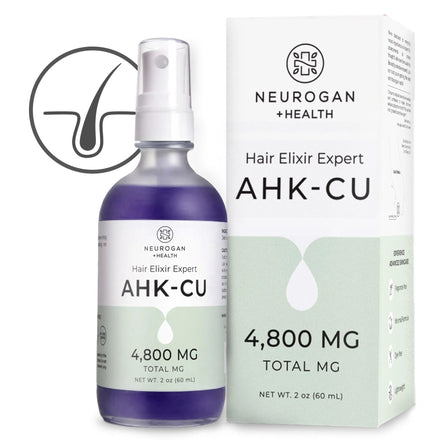
No. AHK-Cu does not block DHT, and it was never designed to. It does not inhibit 5-alpha reductase (the enzyme that makes DHT from testosterone) and it does not sit on the androgen receptor. What it does is act on the other side of the equation: the follicle cells that DHT shrinks. That distinction is the whole reason it can be combined with a DHT blocker, and the reason it has none of their side effects.
What DHT actually does to a follicle
In androgenetic alopecia, follicles on the crown and hairline carry more androgen receptors than follicles at the back of the head. When DHT binds those receptors, the dermal papilla, the cluster of cells at the base that directs growth, starts releasing signals (TGF-beta, DKK-1) that shorten the growth phase and miniaturise the hair. Each cycle the hair comes back thinner and shorter until the follicle produces only vellus fuzz.
There are therefore two places to intervene: reduce the DHT arriving at the follicle, or make the follicle more resistant to it and push it back toward growth. Finasteride and dutasteride do the first. Copper peptides do the second.
What AHK-Cu does instead
The 2007 study that established AHK-Cu for hair exposed cultured human dermal papilla cells and whole follicles to the peptide and measured:1
- Dermal papilla proliferation: increased. More active papilla cells means a stronger growth signal.
- VEGF secretion: increased. VEGF drives the micro-circulation that feeds the follicle (VEGF and hair growth).
- Apoptosis: decreased. The papilla cells were less likely to undergo programmed death, which is one of the ways miniaturisation progresses.
- Follicle elongation: increased over the culture period.
None of those endpoints involve androgen signalling. The follicles were not exposed to DHT in the experiment, and AHK-Cu was not tested as an anti-androgen. It is a growth-side compound.
The related peptide GHK-Cu adds an anti-inflammatory and antioxidant layer that matters in DHT-affected scalps, where micro-inflammation and oxidative stress accelerate miniaturisation.2 That is the mechanism behind how copper peptides reduce the oxidative stress that DHT triggers, and it is why the AHK-Cu Hair Elixir contains both peptides rather than AHK-Cu alone.
So is it useless for DHT-driven hair loss?
No, but be precise about what it can do. If the cause is androgenetic alopecia, DHT keeps arriving at the follicle whether or not you use copper peptides. AHK-Cu makes the follicle healthier and more growth-biased in spite of that; it does not remove the cause. In practice that means:
- Used alone, it can slow miniaturisation and improve density in follicles that are still alive, with a ceiling set by how much DHT pressure remains.
- Used with a DHT blocker, the two address separate mechanisms: the blocker lowers the pressure, the peptide strengthens the response. This is the combination with the best rationale, and it is what we describe in AHK-Cu vs finasteride.
- In non-androgenetic hair loss (telogen effluvium, postpartum shedding, stress shedding) DHT is not the driver, and a growth-side compound is the more relevant tool. See stress-related hair loss.
Why "no DHT blocking" is the point, not a gap
Every side effect that makes people hesitate about finasteride, sexual dysfunction, low libido, mood changes, comes from lowering DHT systemically. Topical anti-androgens reduce but do not remove that risk. Because AHK-Cu does not touch the androgen pathway at all, it has none of those effects, which is why it is usable by women, by men who have stopped finasteride, and by people who simply do not want hormonal treatment. The complete side-effect list is in AHK-Cu side effects.
Natural "DHT blockers" compared
Saw palmetto, pumpkin seed oil and similar are often sold alongside copper peptides. They are weak 5-alpha reductase inhibitors with thin evidence; copper peptides are not inhibitors at all. If you want a DHT reduction, the honest options are finasteride or dutasteride under medical supervision. If you want to avoid the hormonal route, copper peptides are the better-evidenced non-hormonal topical. We compare the natural route directly in AHK-Cu vs saw palmetto.
Frequently asked
Does GHK-Cu block DHT?
No. GHK-Cu has anti-inflammatory, antioxidant and remodelling effects but is not a 5-alpha reductase inhibitor either.
Can I use AHK-Cu while on finasteride?
Yes. One is oral and systemic, the other is topical and local; there is no known interaction and the mechanisms are complementary.
Will AHK-Cu raise my testosterone or DHT?
No. It does not act on androgen synthesis or metabolism in either direction.
If it doesn't block DHT, why does it help a receding hairline?
Because the follicles at a receding hairline are miniaturising, not dead, and a stronger growth signal with better local circulation can keep them producing terminal hair for longer. Expectations are set out in AHK-Cu for receding hairline.
References
- Pyo HK, Yoo HG, Won CH, et al. The effect of tripeptide-copper complex on human hair growth in vitro. Arch Pharm Res. 2007;30(7):834-839. PMID: 17703734.
- Pickart L. The human tri-peptide GHK and tissue remodeling. J Biomater Sci Polym Ed. 2008;19(8):969-988. PMID: 18644225.
Educational content, not medical advice. Androgenetic alopecia is a progressive condition; a dermatologist can confirm the diagnosis and discuss prescription options.