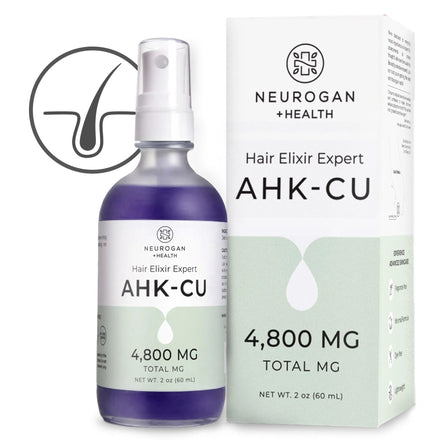
AHK-Cu doesn't work quickly. That's not a failure of the ingredient — it's a reflection of how hair grows.
The hair growth cycle takes months. Anagen (active growth) lasts two to six years, while the visible changes from any treatment targeting the follicle take that long to fully develop. Six months of consistent use is the earliest point where a meaningful assessment can be made. Most people who respond to AHK-Cu notice the first signs — reduced shedding, then fine new hairs — somewhere in the two to four month range.
what is AHK-Cu and How Does It Work?
AHK-Cu (L-Alanyl-L-Histidyl-L-Lysine Copper) is a synthetic copper tripeptide developed for hair follicle stimulation. It targets the dermal papilla — the cluster of specialized cells at the base of the follicle that control whether the follicle is in an active growth phase or a resting phase. Key mechanisms relevant to timeline:- TGF-beta-1 suppression: AHK-Cu reduces TGF-beta-1 signaling in the follicle. TGF-beta-1 is a key inducer of catagen (the regression phase that ends active growth). By reducing it, AHK-Cu helps keep follicles in anagen longer [1].
- Dermal papilla proliferation: Stimulates the dermal papilla cells to proliferate, effectively strengthening the follicle's growth machinery.
- VEGF upregulation: Increases vascular endothelial growth factor, which promotes new capillary formation to improve blood supply to follicles.
- Anti-apoptotic effects: Reduces programmed cell death in follicle cells by approximately 43-78% in cell studies.
None of these processes produce visible hair overnight. They work at the cellular and vascular level, and the effects show up as new hairs — which have to grow from follicle to visible length, a process measured in months.
AHK-Cu Results Timeline: What to Expect Week by Week
| Timeframe | What's Happening | What You Might Notice |
|---|---|---|
| Weeks 1-4 | Topical absorption, early cellular signaling | Nothing visible yet; possible scalp condition improvement |
| Weeks 4-8 | Reduced TGF-beta-1; follicles staying in anagen longer | Daily shedding may decrease; hair feels slightly thicker |
| Months 2-3 | New follicles re-entering anagen after prior quiescence | Fine, colorless or lightly pigmented new hairs in thinning areas |
| Months 4-6 | Active growth of new hairs; VEGF-driven capillary development | Visible changes in coverage and density; hairs gaining length and pigment |
| 6 months+ | Assessment window; full response picture | Meaningful evaluation possible; continued improvement still possible |
Important notes on this timeline:
- These are averages, not guarantees. Individual responses vary.
- People with more active follicles (earlier-stage hair loss) tend to respond faster.
- Consistency matters more than timing. Missing weeks disrupts the cumulative benefit.
Why Hair Loss Treatments Take Months (The Biology Explanation)
Hair grows through a cycle with three main phases: anagen (active growth, lasting years), catagen (regression, 2-3 weeks), and telogen (resting, 3 months), followed by exogen (shedding).Treatments that affect the anagen-catagen decision — like AHK-Cu, minoxidil, and finasteride — do so by altering the cellular signaling that triggers phase transitions. But there's no shortcut: even if a follicle is successfully brought back into anagen immediately, the resulting new hair still takes months to grow to visible length.
The "three months for shedding, six months for growth" framing common in hair loss communities reflects this biology. It isn't unique to AHK-Cu.
Before and After AHK-Cu: What Results Actually Look Like
Month 2-3: First Signs
The first signs of response are typically:- Reduced daily shedding (fewer hairs on the pillow, in the shower drain)
- Fine, "baby" hairs appearing along the hairline or in thinning areas — often unpigmented or lightly colored at first
Month 4-6: Visible Changes
By four to six months, responding users typically see:- Increased coverage in previously thinning areas
- Improved hair density (often measured by how the scalp is visible under bright light)
- New hairs that have grown to a length where they contribute to visual fullness
Six Months and Beyond
Six months is the assessment checkpoint. Users who see no change by six months of consistent daily use are less likely to be responders (though continued use at that point doesn't carry significant risk). Users who see improvement at six months may continue to see gains through 12 months and beyond.Comparing AHK-Cu Timeline to Other Hair Loss Treatments
| Treatment | First Signs | Meaningful Results | Assessment Window |
|---|---|---|---|
| AHK-Cu (topical) | 2-3 months | 4-6 months | 6 months |
| Minoxidil (topical) | 3-4 months | 4-6 months | 6 months |
| Finasteride | 3-6 months (slowing loss) | 6-12 months | 12 months |
| PRP (platelet-rich plasma) | 3-4 months | 4-6 months | 6 months |
| microneedling | 3-4 months | 4-6 months | 6 months |
| Hair transplant | 6-12 months (post-op growth) | 12-18 months | 18 months |
The timelines are similar across most hair loss treatments, because they're all constrained by the same biological bottleneck: hair growth takes time.
How to Know If AHK-Cu Is Working
Signs of Response
- Reduction in daily shedding count
- Fine new hairs in areas that were previously thinning
- Improved scalp coverage under direct lighting or parting
- Hair that feels denser or fuller at the roots
Signs It May Not Be Working
- No change in shedding pattern after three months
- No new hair visible in thinning areas at four to five months
- Continued visible progression of hair loss despite consistent use
The Trichoscopy Approach
A dermatologist can perform trichoscopy — a magnified examination of the scalp — to count follicular units and assess hair shaft diameter before and after treatment. This is the most objective way to measure early response before visual changes are obvious.What Affects How Fast AHK-Cu Works?
| Factor | Effect |
|---|---|
| Stage of hair loss | Earlier-stage loss → more viable follicles → faster, more pronounced response |
| Consistency of application | Daily use is essential; gaps delay and dilute results |
| Application technique | Proper delivery to scalp surface (not just hair) affects absorption |
| Combination with other treatments | Minoxidil + AHK-Cu can produce more robust results |
| Underlying causes of hair loss | AGA responds differently than telogen effluvium or nutritional-deficiency loss |
| Age | Younger follicles tend to be more responsive |
Frequently Asked Questions
How long should I try AHK-Cu before giving up?
Six months of consistent daily use is the minimum meaningful trial. Stopping at two or three months because you don't see results is stopping before the biology has had time to work.Does AHK-Cu work faster if I apply it more often?
Twice daily is the recommended protocol and provides incrementally better results than once daily. Beyond twice daily, there is no evidence that more applications produce faster or better results.Can I speed up results with microneedling?
Yes. Microneedling creates temporary micro-channels in the scalp that allow copper peptides to penetrate more deeply into the dermis. Applied immediately after a needling session, AHK-Cu may produce results faster than topical application alone. See the microneedling + copper peptides article for protocol details.Will the results last if I stop?
The improvements from AHK-Cu appear to gradually diminish after stopping, because the follicle-stimulating mechanisms are no longer active. Unlike finasteride, there is no dramatic "rebound shedding" associated with stopping. Gradual reversal over months is the more typical pattern.References
- Pyo, H. K., et al. (2007). The effect of tripeptide-copper complex on human hair growth in vitro. Archives of pharmacal research, 30(7), 834-839.
- Lee, W. J., et al. (2016). Efficacy of a complex of 5-aminolevulinic acid and glycyl-histidyl-lysine peptide on hair growth. Annals of dermatology, 28(4), 438-443.
- Messenger, A. G., & Rundegren, J. (2004). Minoxidil: mechanisms of action on hair growth. British Journal of Dermatology, 150(2), 186-194.