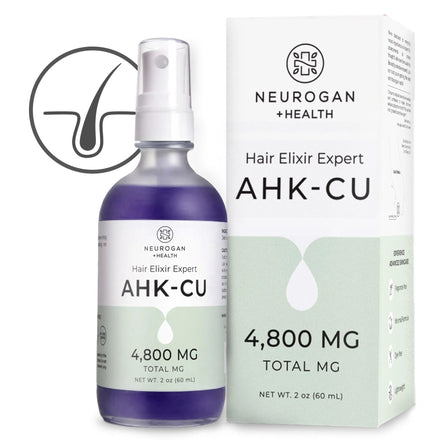
AHK-Cu is sold two ways: as lyophilised powder in 100 mg or 200 mg vials from research-peptide vendors, and as a finished topical serum. The powder looks cheaper per milligram. By the time it is a usable scalp solution, it usually is not, and the things you give up along the way, verified purity, correct concentration, stability and a preservative-free formula that still stays clean, are exactly the things that decide whether the peptide works. Here is the honest comparison.
What you are actually buying
| AHK-Cu powder | Finished serum (AHK-Cu Hair Elixir) | |
|---|---|---|
| Form | Freeze-dried peptide in a vial, "research use only" | AHK-Cu + GHK-Cu dissolved in purified water, 4,800 mg per 60 mL |
| Purity | Whatever the vendor's certificate says; often no certificate | 99% HPLC-verified, batch certificate published |
| Concentration | You calculate it; errors are common | Fixed: 2,400 mg of each peptide per bottle |
| Solvent | Bacteriostatic water (meant for injection), or tap water | Purified water, no alcohol, no glycols |
| Stability | Days to a few weeks once reconstituted, refrigerated | Shelf-stable sealed; use within the labelled period after opening |
| Contamination risk | Yours to manage: open vials, syringes, storage | Filled in a GMP facility (what that means) |
| Legal status | Research chemical; not for human use per the label | Cosmetic topical for scalp use |
The cost calculation people skip
A typical 200 mg AHK-Cu vial costs in the range of $60 to $120 depending on vendor and purity claims. To match the serum's AHK-Cu content (2,400 mg) you would need 12 vials, which is $720 to $1,440 of powder before solvent, syringes, a scale and the time to make it up every couple of weeks. Even allowing for DIY solutions at lower concentrations, the cheapest realistic DIY comes out at roughly the same monthly cost as the finished product, with none of the verification. The economics only favour powder if you are making a very dilute solution, and then you are no longer using a dose comparable to the one in the research-derived formulations.
Four ways DIY serums go wrong
- Wrong concentration. Cosmetic AHK-Cu solutions sit in a defined range; too dilute does nothing, too concentrated wastes peptide and stains. Getting it right needs a milligram scale and a pipette, not a kitchen measuring spoon.
- Copper dissociation. Copper peptides are complexes; the wrong pH or the wrong solvent can strip the copper from the peptide, leaving free copper (an irritant) and a peptide that no longer does what the study measured.
- Microbial growth. A water solution with no preservative is a growth medium. Finished serums handle this with sterile filling and sealed dispensers; a DIY bottle opened daily does not.
- Degradation. Peptides in solution degrade with light, heat and time. A DIY batch made for a month has lost potency long before it runs out.
When powder makes sense
If you are a formulator or a lab with HPLC access and a reason to test your own concentrations, powder is the right input. If you are a person with thinning hair who wants the effect shown in the research, it is the wrong one. The research was done on a defined solution applied to follicle tissue1; the closest a consumer gets to that is a finished, verified serum applied daily to the scalp.
What to look for in a finished serum instead
- Both peptides named by INCI: Copper Tripeptide-3 (AHK-Cu) and Copper Tripeptide-1 (GHK-Cu). The 1:1 ratio rationale is here.
- Total peptide content in mg on the label, not a percentage of a "complex".
- A downloadable certificate of analysis per batch (how to read one).
- A short ingredient list; the three-ingredient argument explains why that matters on a daily scalp product.
- A dispensing format that keeps the solution sealed between uses.
That is the checklist the AHK-Cu Hair Elixir was built against, and the one we apply to competitors in best copper peptide products.
Frequently asked
Can I add AHK-Cu powder to my existing shampoo or conditioner?
Not usefully. Surfactants and the wrong pH destabilise the complex, and a rinse-off product gives the peptide seconds of contact time. Leave-on application to the scalp is the route in the research.
Is AHK-Cu powder the same thing vendors sell for injection?
Yes, the vial is the same; the use is what differs. There is no human injection data for AHK-Cu, which we cover in Is AHK-Cu injectable?
How should a finished serum be stored?
Cool, dark, sealed. Refrigeration is optional but extends life after opening. Avoid leaving it in a hot bathroom window.
References
- Pyo HK, Yoo HG, Won CH, et al. The effect of tripeptide-copper complex on human hair growth in vitro. Arch Pharm Res. 2007;30(7):834-839. PMID: 17703734.
Educational content, not medical advice. Prices quoted are typical market ranges at time of writing and will vary.