The hair loss product market is full of formulas with 30, 40, or 50 ingredients. A quick scan of popular "hair growth serums" reveals a common pattern: a long list of botanicals, peptides, amino acids, vitamins, and plant extracts that reads impressively but may not translate to better outcomes.
The minimal formula approach starts from a different premise: every ingredient added to a formula is a potential source of irritation, instability, or interaction. More ingredients don't make a formula more effective — they make it more complex.
Why the Scalp is Different from Skin
The scalp has some of the highest sebum output of any skin area and contains a dense concentration of hair follicles. It's also frequently disrupted by:- Shampoos and conditioners (often alkaline, stripping the acid mantle)
- Heat styling
- Hair dye and bleach (strong oxidizing agents)
- Friction from hats, helmets, and tight hairstyles
- Environmental pollution and UV exposure
The scalp's microbiome is complex — dysbiosis (imbalance) is linked to dandruff, seborrheic dermatitis, and potentially follicular inflammation that accelerates hair loss. Many well-intentioned ingredients can disrupt this balance.
A formula designed to deliver copper peptides to the follicle has a narrow job: get the actives to the scalp, stay there, and don't create unnecessary disruption.
What AHK-Cu and GHK-Cu Need to Work
Two things above all else:- Stability: The copper-peptide bond is stable at approximately pH 4-7. In strongly acidic or alkaline environments, the bond degrades, releasing free copper ions that are no longer in their bioavailable peptide form.
- Penetration: Leave-on application (not rinse-off) allows contact time for the peptide to reach the dermis and dermal papilla. Vehicles that maintain the formula at the skin surface without promoting penetration reduce efficacy.
A formula optimized for these two things doesn't need many ingredients.
The Case for Fewer Ingredients
Fewer Potential Irritants
Sensitization and irritant contact dermatitis from cosmetics is largely driven by fragrance, preservatives, and certain botanical extracts [1]. Every additional ingredient beyond what's needed for efficacy introduces a sensitization risk.On the scalp, irritation matters more than on other skin areas because chronic inflammation is associated with progressive hair loss. Adding ingredients that might cause irritation works against the goal.
Better Formula Stability
More complex formulas have more potential for ingredient interactions. Specific incompatibilities relevant to copper peptides:- Ascorbic acid (vitamin C): pH conflict; degrades the copper-peptide bond
- High-concentration AHAs: similar pH concern
- Strong oxidizing agents: can destabilize peptides
A formula containing ascorbic acid and copper peptides is either poorly formulated or relying on concentrations too low to have effect.
Higher Active Ingredient Concentration
With a small ingredient list, a larger proportion of the formula can be devoted to the actives. A 30-ingredient formula where most additions are marketing-driven botanicals at negligible concentrations may have less copper peptide than a 5-ingredient formula focused on delivering the active.Transparency
A short INCI list is easier to evaluate. With 3-5 ingredients, it's straightforward to verify that the actives are present and at a reasonable position in the list. With a 40-ingredient list, identifying whether the copper peptide is at a meaningful concentration or a trace amount becomes much harder.The Neurogan Health AHK-Cu Formula: Three Core Ingredients
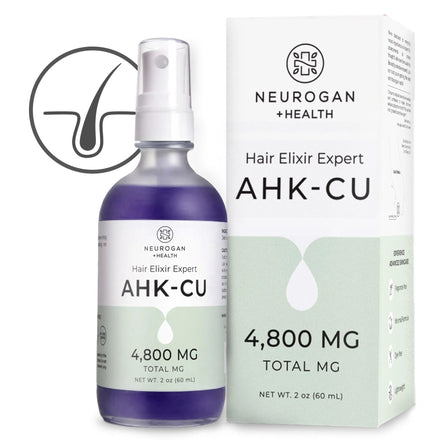
The Neurogan Health copper peptide scalp serum is built around three core actives:- Copper Tripeptide-3 (AHK-Cu): For direct follicle cell stimulation, TGF-beta-1 suppression, anti-apoptotic effects, and VEGF upregulation.
- copper tripeptide-1 (GHK-Cu): For scalp collagen support, anti-inflammatory effects, wound healing properties, and broader VEGF support.
- A minimal, pH-balanced vehicle: Formulated at the pH range that maintains copper-peptide bond stability.
This is the complete active story. There are no hidden botanical extras designed to pad the ingredient list, no fragrance, and no novel ingredients that add marketing value but require additional data on stability and compatibility.
What a Good Minimal Formula Looks Like
| Characteristic | What to Look For |
|---|---|
| pH range | 4-7 (stable for copper-peptide bond) |
| Fragrance | Absent |
| Active position in INCI list | Copper peptide(s) in the first half |
| Preservative system | Simple, well-studied (phenoxyethanol, or none if anhydrous) |
| Incompatible actives | No ascorbic acid, no high-concentration AHAs in same formula |
| Format | Leave-on (not rinse-off) |
When More Ingredients Are Justified
Not every ingredient beyond the minimum is unnecessary. Some additions genuinely improve performance:- Hyaluronic acid: A vehicle ingredient that improves skin feel and hydration; doesn't interfere with copper peptides.
- Niacinamide: Complementary anti-inflammatory, barrier-supporting active; compatible with copper peptides.
- biotin: No evidence of benefit for hair unless there's a documented deficiency, but harmless.
The difference is between ingredients that serve the formula (improve delivery, stability, or user experience without introducing incompatibility) and ingredients that serve marketing copy.
Red Flags in Hair Serum Formulations
| Red Flag | Why It Matters |
|---|---|
| "Copper peptides" in marketing copy but absent from INCI | The ingredient may not be present |
| Copper peptides plus ascorbic acid in same formula | pH incompatibility; likely one or both at low concentrations |
| Copper peptides at the very end of a long INCI list | Likely at concentrations too low to have effect |
| Fragrance or essential oils high in the list | Primary sensitization risk on scalp |
| "Proprietary blend" without INCI names | No way to evaluate what's present or at what concentration |
Why This Matters for Outcomes
Hair loss treatment is already a months-long endeavor. The goal is to keep as many variables consistent as possible over that time. A formula that causes contact dermatitis, disrupts the scalp microbiome, or introduces an incompatible active doesn't just fail to help — it can set back progress.A formula with three carefully selected, compatible ingredients that are stable at the right pH, applied consistently to a clean scalp over six months, is more likely to produce the expected outcome than a 40-ingredient "advanced complex" that introduces unnecessary variables.
References
- Zug, K. A., et al. (2009). Patch-test results of the North American Contact Dermatitis Group. Dermatitis, 20(3), 149-160.
- Pyo, H. K., et al. (2007). The effect of tripeptide-copper complex on human hair growth in vitro. Archives of pharmacal research, 30(7), 834-839.