Graphic titled “AHK-Cu and Microneedling: The Complete Protocol for Hair Regrowth” showing a person receiving a microneedling treatment on the scalp for hair restoration, with the AHK~Cu logo at the bottom.
Microneedling and copper peptides work on complementary problems. Microneedling creates the access channels — copper peptides supply the signal.
On their own, each has a credible mechanism for supporting hair growth. Together, they address the delivery limitation that holds back most topical hair treatments: getting the active past the skin barrier and into the tissue where follicles actually live.
what is AHK-Cu? (Copper Tripeptide-3 Explained)
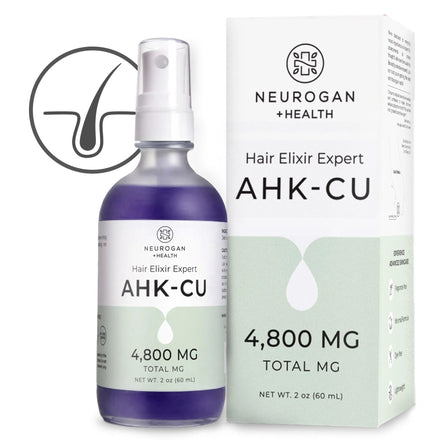
AHK-Cu, also known as Copper Tripeptide-3, is a bioactive copper peptide complex studied for its ability to stimulate hair follicle regeneration at the cellular level. It‘s made up of three amino acids, alanine, histidine, and lysine, chelated to a copper(II) ion. This version of copper peptide doesn’t occur naturally in the body — it was synthetically engineered with hair follicle tissue as its target.
The single structural difference between AHK-Cu and its naturally occurring cousin GHK-Cu (copper tripeptide-1) is the amino acid at position one: glycine in GHK-Cu, alanine in AHK-Cu.
That substitution is thought to more specifically shift the peptide's receptor affinity toward hair follicle cells. GHK-Cu has the longer research history and the broader tissue-repair profile, but AHK-Cu has the more targeted, follicle-specific evidence base.
In hair growth research, AHK-Cu was first studied in a 2007 paper from Seoul National University, which found statistically significant hair follicle elongation and dermal papilla cell proliferation in human follicle cultures [1].
A 2016 randomized study of 45 patients with androgenetic alopecia reported 52-71 new hairs at 6 months with GHK-Cu [2]. These two studies are the primary evidence base for its hair growth applications.
How Does Microneedling Promote Hair Growth?
Microneedling uses fine needles to create controlled micro-injuries in the scalp dermis. That sounds counterintuitive as a treatment for hair growth, but the wound healing cascade it triggers is where most of the benefit comes from.
The Wound Healing Response
When the scalp dermis is punctured by microneedles, the body initiates a repair sequence.
Platelets aggregate at injury sites, releasing growth factors such as PDGF (platelet-derived growth factor), TGF-beta, and VEGF. These signals recruit fibroblasts to the area, stimulate collagen production, and promote the formation of new blood vessels. In the vicinity of hair follicles, this creates a local environment enriched in the same growth factors that support follicle activity during anagen [3].
Wnt Pathway Activation
Microneedling has been associated with activation of the Wnt/beta-catenin signaling pathway in scalp tissue [4].
The Wnt pathway is key to hair follicle development, cycling, and the regeneration of follicle stem cells. Activating it through controlled mechanical stimulation may help push dormant or miniaturized follicles back toward active cycling.
Stem Cell Activation
Follicle stem cells, located in the bulge region of the hair follicle, are involved in regenerating the follicle at the start of each anagen phase.
Microneedling-induced tissue remodeling may activate these stem cells by disrupting the local environment that keeps them quiescent. This is one of the proposed mechanisms for why microneedling produces hair-growth responses that go beyond what simple scalp stimulation alone can explain.
The Penetration Enhancement Effect
Beyond its direct biological effects, microneedling dramatically improves the penetration of topically applied actives.
The stratum corneum, the outermost skin layer, is the primary barrier preventing most topical compounds from reaching the dermis efficiently. Microneedles create temporary channels through this barrier.
Studies on topical drug delivery with microneedling have documented penetration improvements of ten to twenty times compared to application on intact skin, depending on needle depth, compound molecular weight, and timing of application [5].
For AHK-Cu, this means the concentration reaching dermal papilla cells after microneedling can be substantially higher than that delivered by a serum applied to an untreated scalp.
The Science: How AHK-Cu Targets Hair Follicles
This is where we get a little more technical on how AHK targets hair follicles. While most of this research is newer and is still quite limited, there’s a lot we can learn here, and it shows promise for more research on AHK for hair growth in the future.
Dermal Papilla Cell Stimulation and Survival
At the base of each hair follicle is a tiny cluster of “control center” cells called dermal papilla cells, which help decide how long and how thick hair grows.
In lab studies, AHK‑Cu helped these cells multiply and cut key cell‑death signals roughly in half or more, suggesting it may help follicles maintain their growth‑driving cells for longer [1].
VEGF Upregulation
Lab studies show that AHK‑Cu can nudge skin cells to make more VEGF — a signal that helps grow tiny new blood vessels — potentially improving blood supply around hair roots [1].
Microneedling, in turn, triggers a short‑term burst of VEGF as part of the normal wound‑healing response, so using AHK‑Cu between sessions may help support the same pro‑blood‑flow pathway over time, even though this specific combination has not yet been formally tested in scalp studies.
anagen phase Extension
TGF‑β1 is one of the signals that tells hair follicles it’s time to stop growing and move into the regression phase of the cycle. In cell studies, copper tripeptides like AHK‑Cu have been shown to lower TGF‑β1 secretion from dermal fibroblasts, which suggests they may help dial down this “slow‑down” signal around follicles, although this hasn’t yet been proven to lengthen the growth phase in human scalps [6].
Oxidative Stress and DHT
DHT is the hormone that directly shrinks vulnerable hair follicles in pattern hair loss, and drugs like finasteride lower it at the source.
AHK‑Cu doesn’t work that way — it doesn’t block DHT in the body, and any hormone‑related effect would be secondary to its role in calming oxidative stress and supporting follicle health, so it should be seen as a complement, not a DHT‑blocking substitute.
AHK-Cu vs GHK-Cu: Which Copper Peptide Is Better for Hair?
This question matters for the microneedling protocol specifically because many products contain one or the other, or both, and knowing what each contributes helps you choose the right formula to apply post-needling.
|
AHK-Cu (Copper Tripeptide-3) |
GHK-Cu (Copper Tripeptide-1) |
|
|
Origin |
Synthetic |
Naturally occurring in human plasma |
|
Amino acid at position 1 |
Alanine |
Glycine |
|
Primary research focus |
Hair follicle stimulation; DPC proliferation |
Skin repair; collagen; wound healing; anti-inflammatory |
|
Best human hair trial |
Lee 2016: n=45, +52–71 new hairs at 6 months |
Small vs. minoxidil comparison: follicle size improvement |
|
Post-needling use |
Directly targets DPCs at the follicle base |
Supports tissue repair in the needled dermis |
|
Best used together? |
Yes, mechanisms complement each other |
Yes, GHK-Cu supports the environment AHK-Cu targets |
For microneedling specifically, a formula containing both is the most well-rounded choice.
GHK-Cu addresses the wound-healing and tissue-repair responses that needling triggers; AHK-Cu targets dermal papilla cells directly while those channels are open. Products formulated with both Copper Tripeptide-1 and Copper Tripeptide-3 are designed with this complementary logic in mind.
The Complete AHK-Cu and Microneedling Protocol (Step-by-Step)
This protocol is intended for home use with a dermaroller or dermastamp. If you are working with a dermatologist or trichologist, follow their clinical protocol — needle depths and session frequency may differ under professional supervision.
Choosing Your Tool
Two tools are commonly used for at-home scalp microneedling: a dermaroller (a roller covered with fine needles) and a dermastamp (a stamp device that delivers needles vertically).
The dermastamp is generally preferred for the scalp because it delivers a more consistent vertical needle depth on uneven surfaces, whereas a roller can produce inconsistent depth as it moves across curves. Either can be used effectively with the right technique.
Needle Depth by Goal
|
Needle Depth |
Target Depth |
Best For |
Notes |
|
0.25 mm |
Epidermis only |
Product penetration enhancement; beginners |
Minimal tissue injury; least growth factor response; safest starting point |
|
0.5 mm |
Upper dermis |
Balanced: penetration + wound response |
Most commonly recommended depth for home scalp use |
|
1.0 mm |
Mid-dermis |
Stronger wound healing stimulus; closer to the follicle bulge |
Greater risk of irritation; approach with caution at home |
|
1.5 mm+ |
Deep dermis |
Clinical setting only |
Requires professional supervision; risk of follicle damage if misused |
For most home users, 0.5 mm is the recommended starting depth. It reaches the upper dermis, elicits a meaningful wound-healing response, and significantly improves AHK-Cu penetration without requiring clinical supervision.
If you experience significant irritation at 0.5 mm, step down to 0.25 mm and give your scalp more time to adapt.
Session Frequency
Once per week is the standard starting protocol for home scalp microneedling. The scalp needs time to complete the wound healing response between sessions. Doing it more frequently than once a week doesn't accelerate results and risks chronic irritation or barrier damage.
Once your scalp has adapted (typically after four to eight sessions), some practitioners move to once every two weeks, allowing more complete tissue recovery between cycles.
Daily rolling with dermarollers marketed as scalp treatments at a depth of 0.1 to 0.2 mm is a different approach and does not produce the same wound-healing response as weekly 0.5 mm sessions.
Those daily formats primarily enhance product penetration rather than stimulating a tissue repair response.
Step-by-Step Protocol
|
Step |
Action |
Detail |
|
1 |
Sanitize your tool |
Soak roller or stamp in 70% isopropyl alcohol for 5–10 minutes before each session. Rinse with sterile saline. Never share tools. |
|
2 |
Wash and dry your scalp |
Shampoo with a gentle, sulfate-free formula. Towel-dry until the scalp is no longer wet to the touch. |
|
3 |
Optional: apply numbing cream |
A topical anesthetic (lidocaine cream) applied 30–45 minutes before needling reduces discomfort, particularly at 0.5 mm+ depth. Wipe clean before needling. |
|
4 |
Part hair into treatment sections |
Work through the scalp in sections so you cover the treatment area systematically. Crown, frontal zone, temples. |
|
5 |
Needle each section |
For a roller: 4–6 passes in each direction (vertical, horizontal, diagonal) over each section. For a stamp: even pressure, cover the section systematically. Do not press so hard that you feel sharp pain. |
|
6 |
Wipe away any blood or lymph fluid |
Light pinpoint bleeding is normal at 0.5 mm. Blot with a sterile gauze pad. Heavy bleeding means you are pressing too hard. |
|
7 |
Apply AHK-Cu serum or spray immediately |
Apply within 5–10 minutes of needling while micro-channels are still open. Apply generously to all treated sections. Massage in gently. |
|
8 |
Leave on; do not rinse |
The serum needs to absorb. Do not shampoo for at least 24 hours post-needling. |
|
9 |
Continue daily serum application on non-needling days |
Apply AHK-Cu once or twice daily every day between sessions. Needling days are weekly; the serum routine is daily. |
What Not to Do on Needling Day
Do not apply vitamin C (ascorbic acid), retinoids, strong AHAs, or any strongly acidic product to the needled scalp.
The micro-channels significantly increase the penetration of everything applied to the scalp, including ingredients that could irritate already traumatized tissue. Stick to the copper peptide serum and a gentle non-medicated moisturizer if the scalp feels tight after the session.
What Results to Expect (and When)
The microneedling plus AHK-Cu combination typically shows results faster than topical copper peptides alone, because the dramatically improved penetration allows higher effective concentrations of the active ingredient to reach dermal papilla cells with each session. That said, hair biology still sets the pace.
|
Timeline |
What You Might Notice |
|
4–6 weeks |
Reduced shedding; improved scalp condition; early signs of the anti-inflammatory effect |
|
2–3 months |
Fine new hairs appearing in treated areas, follicles re-entering anagen |
|
3–6 months |
Visible density improvements in treated zones, existing hairs are thicker from longer anagen cycles |
|
6–12 months |
Full picture of individual response, most significant changes visible in side-by-side photos |
A 2013 randomized controlled trial compared scalp microneedling plus minoxidil against minoxidil alone in 100 men with androgenetic alopecia. The microneedling plus minoxidil group showed a mean hair count increase of 91.4 hairs versus 22.2 hairs in the minoxidil-only group at 12 weeks [7].
That study used minoxidil rather than AHK-Cu as the topical active, but the magnitude of the penetration-enhancement effect it demonstrates is relevant context for what microneedling can do for any topical applied post-procedure.
Results vary by hair loss stage, individual biology, protocol consistency, and whether other treatments are used alongside. Someone in the early stages of androgenetic alopecia with follicles still active but declining will respond differently than someone with years of significant miniaturization. Set the six-month mark as your realistic evaluation window.
Safety, Side Effects, and Who Should Avoid This Protocol
Light pinpoint bleeding during the session at 0.5 mm is normal and expected. Scalp redness and mild tenderness for 24 to 48 hours post-session are also common and typically resolve without intervention.
Some people experience mild itching as the scalp heals, which is part of the normal repair process. These effects are more pronounced immediately after the session and diminish over the following day or two.
Infection Risk
This is the most significant risk of home scalp microneedling, and it's entirely preventable with proper tool sanitation.
Use 70% isopropyl alcohol to sterilize before every session. Never share tools. Do not needle over any area that has an active lesion, infection, wound, or skin condition.
Replace needle cartridges or rollers regularly — dull needles cause more tearing and increase the risk. If you notice signs of infection after a session (increasing redness, warmth, swelling, discharge) rather than the expected 24 to 48-hour post-session irritation, seek medical attention.
Who Should Avoid This Protocol
This protocol isn’t ideal for everyone. Avoid scalp microneedling if you have active scalp infections, seborrheic dermatitis flares, scalp psoriasis, or any open wounds or lesions in the treatment area.
People on anticoagulants (blood thinners) should consult their physician before starting, as controlled bleeding is part of the expected wound response, and these medications can significantly affect it.
People with keloid-forming skin, a history of hypertrophic scarring, or known clotting disorders should discuss this protocol with a dermatologist before attempting it at home. And those with alopecia areata should note that the mechanism differs from androgenetic alopecia, and you should seek more professional advice.
If you are pregnant, consult your healthcare provider before starting any new scalp treatment protocol, including microneedling.
AHK-Cu safety at the Needled Scalp
AHK-Cu has not been associated with significant adverse effects at topical concentrations in published research.
However, post-needling skin has a compromised barrier, meaning everything applied penetrates more deeply and in greater quantities than it would on intact skin. This is the intended effect of the copper peptide, but it also means you should avoid applying anything with known irritant potential during the post-needling window.
Stick strictly to the copper peptide serum and avoid other actives on needling day.
Combining AHK-Cu and Microneedling with Other Hair Loss Treatments
With Minoxidil
The 2013 RCT mentioned earlier specifically studied microneedling combined with minoxidil and found a dramatic improvement in minoxidil outcomes [7].
If you are already using minoxidil, combining it with weekly microneedling is well-supported. Some users apply AHK-Cu on needling days and minoxidil on non-needling days, or apply AHK-Cu post-needling and add minoxidil the following morning when the micro-channels have closed. This avoids any concern about enhanced penetration of minoxidil's vasodilatory effects into the systemic circulation via newly formed microchannels.
With Finasteride
Finasteride is taken orally, so there is no concern about topical compatibility with microneedling.
The combination makes biological sense: finasteride reduces the DHT, causing ongoing follicle miniaturization; microneedling plus AHK-Cu supports follicle cell health and growth in that improved hormonal environment. No special timing considerations apply.
With PRP
PRP (platelet-rich plasma) injections are sometimes combined with microneedling as a combined clinical procedure.
In some protocols, a PRP serum is applied topically after microneedling rather than injected, allowing the enhanced penetration to deliver growth factors into the dermis. If you are receiving clinical PRP treatment, discuss with your practitioner whether applying AHK-Cu at home between sessions is a good idea for your protocol.
With Caffeine
Topical caffeine is used in some hair formulations for its vasodilatory effect on scalp blood vessels, complementing AHK-Cu's VEGF-driven angiogenesis through a different mechanism of action.
Caffeine is pH-neutral and compatible with copper peptides in the same routine, though applying it in the same step post-needling is not necessary. Using a caffeine scalp treatment on non-needling days is a reasonable addition if it's already part of your routine.
Full Protocol Summary
|
Treatment |
When to Apply |
Mechanism Added |
Compatible? |
|
AHK-Cu serum/spray |
Daily, immediately post-needling on session days |
|
Core of this protocol |
|
GHK-Cu (combined formula) |
Same as AHK-Cu, preferably in a dual-peptide product |
|
Yes, recommended |
|
Minoxidil |
Non-needling days, or the morning after a needling day |
|
Yes, sequence carefully |
|
Finasteride (oral) |
Daily as prescribed, no topical interaction |
|
Yes, no conflict |
|
PRP |
Clinical sessions, AHK-Cu topically between |
|
Yes, discuss with your practitioner |
|
Caffeine scalp treatment |
Non-needling days |
|
Yes, neutral pH |
The case for combining AHK-Cu with scalp microneedling makes sense in a lot of ways. Microneedling creates the access, and AHK-Cu supplies the signal.
The wound-healing response to needling also produces an endogenous burst of growth factors and improved local circulation, and the copper peptide extends and amplifies this effect through direct stimulation of dermal papilla cells, sustained VEGF upregulation, and anagen phase extension.
The combination addresses the primary limitation of topical copper peptides, which is how little of a standard serum actually reaches the dermis, and amplifies the primary effect of microneedling, which is creating a tissue environment receptive to growth signals.
The protocol is not complicated. Clean scalp, sterile tool, 0.5 mm depth, AHK-Cu applied immediately after, copper peptide serum daily between sessions. Done consistently over six months, this is one of the more rationally designed non-prescription hair regrowth protocols available.
What it isn't: a replacement for finasteride or minoxidil in cases of significant androgenetic alopecia, a protocol for alopecia areata or scarring alopecia, or a quick fix. Biology determines the timeline, and it's months. But for people committed to addressing hair loss at the cellular level, this combination is worth taking seriously.
References
-
Pyo, H. K., Yoo, H. G., Won, C. H., Lee, S. H., Kang, Y. J., Eun, H. C., Cho, K. H., & Kim, K. H. (2007). The effect of tripeptide-copper complex on human hair growth in vitro. Archives of Pharmacal Research, 30(7), 834–839.
-
Lee, W. J., Lee, S. M., Choe, Y. B., & Ahn, K. J. (2016). Effects of copper-tripeptide on hair growth in a mouse model and in human dermal papilla cells. Annals of Dermatology, 28(4), 413–419.
-
Manole, C. G., Soare, C., Ceafalan, L. C., & Voiculescu, V. M. (2023). Platelet-rich plasma in dermatology: new insights on the cellular mechanism of skin repair and regeneration. Life, 14(1), 40.
-
Kim, Y. S., Jeong, K. H., Kim, J. E., Woo, Y. J., Kim, B. J., & Kang, H. (2016). Repeated microneedle stimulation induces enhanced hair growth in a murine model. Annals of dermatology, 28(5), 586-592.
-
Ita, K. (2015). Transdermal delivery of drugs with microneedles—potential and challenges. Pharmaceutics, 7(3), 90-105.
-
Gruchlik, A., Chodurek, E., & Dzierzewicz, Z. (2014). Effect of GLY-HIS-LYS and its copper complex on TGF-β secretion in normal human dermal fibroblasts. Acta Pol. Pharm, 71(6), 954-958.
-
Dhurat, R., Sukesh, M. S., Avhad, G., Dandale, A., Pal, A., & Pund, P. (2013). A randomized evaluator blinded study of effect of microneedling in androgenetic alopecia: a pilot study. International journal of trichology, 5(1), 6-11.