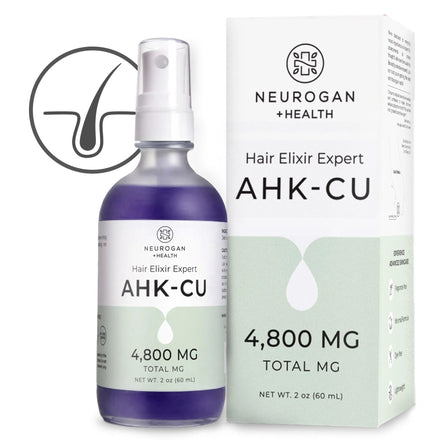
AHK-Cu has a favorable safety profile based on available research. At the concentrations used in cosmetic formulations applied topically to the scalp, no significant adverse effects have been documented in the published literature. There are no reported hormonal effects, systemic toxicity concerns at cosmetic doses, or documented interactions with common hair loss medications.
That said, "no significant adverse effects documented" is not the same as "completely proven safe for everyone in all situations." Here is what the evidence shows, where the legitimate cautions are, and how to identify if AHK-Cu is right for you.
what is AHK-Cu?
AHK-Cu (copper tripeptide-3, L-Alanyl-L-Histidyl-L-Lysine copper) is a synthetic copper tripeptide chelated to a copper(II) ion. It was developed for hair follicle stimulation applications.Its chemical structure and mechanism separate it from free copper ions. Free ionic copper can generate reactive oxygen species via Fenton-type chemistry and is a regulated heavy metal in many regulatory frameworks. AHK-Cu is copper bound to a peptide carrier — the peptide directs copper to specific tissue receptors rather than releasing free ions into general circulation.
clinical evidence on AHK-Cu Safety
The primary published clinical evidence for AHK-Cu safety comes from studies of copper peptide complexes in scalp application: Pyo et al. (2007): In vitro study in human follicle cultures. No cell toxicity at studied concentrations [1]. Lee et al. (2016): Randomized controlled trial of 45 patients over six months. The study reported no significant adverse events [2]. GHK-Cu safety data: GHK-Cu (the closely related naturally occurring copper peptide) has been studied since the 1970s across wound healing, skin aging, and cosmetic applications, consistently showing an excellent safety profile. This provides relevant context for the copper peptide class generally.Systemic Safety: Does AHK-Cu Affect Hormones or Internal Organs?
No hormonal effects have been documented from topical copper peptide application. AHK-Cu is not a DHT blocker, does not affect testosterone, estrogen, or other sex hormones, and has no mechanism known to produce systemic hormonal changes. No organ toxicity at topical cosmetic concentrations. Copper is an essential trace mineral; the body has mechanisms to regulate excess copper. The amount delivered topically via a cosmetic serum is orders of magnitude below levels associated with copper toxicity. No systemic absorption concern at standard cosmetic concentrations. Topical peptides have limited systemic absorption by virtue of the skin barrier. The amounts reaching circulation are negligible.Side Effects: What to Watch For
The most commonly reported side effect with copper peptide scalp products is mild, temporary scalp irritation in some individuals — particularly those with sensitive skin or a compromised scalp barrier. This is not unique to copper peptides; it's a general feature of applying any active serum to a scalp with pre-existing irritation or sensitivity. Signs to watch for:| Symptom | What It May Indicate | What to Do |
|---|---|---|
| Mild itching or tingling at application site | Possible mild sensitivity | Discontinue for a few days; patch test first |
| Persistent redness or burning | Contact irritation or allergy | Discontinue; consult dermatologist if persists |
| Widespread hives or swelling | Allergic reaction (rare) | Discontinue immediately; seek medical attention |
| No symptoms | Normal | Continue as directed |
Who Should Not Use AHK-Cu
Wilson's Disease
Wilson's disease is a rare autosomal recessive genetic disorder affecting copper metabolism. Patients accumulate copper in the liver, brain, and other organs because the mechanism for excreting excess copper is impaired. People with Wilson's disease should not use copper peptide products without explicit medical guidance, as additional topical copper may be inadvisable.Infected, Broken, or inflamed scalp
Applying actives to a compromised scalp barrier — whether from infection, open wounds, active psoriasis, or severe seborrheic dermatitis — increases the risk of absorption of unintended substances and may worsen the condition. Resolve any active scalp condition before beginning treatment.Known Metal Sensitivity
Rare individuals have known sensitivities or allergies to copper or related metals. If you have a documented metal sensitivity, patch test first.Pregnancy
There is no published evidence of harm from topical copper peptide application during pregnancy. The default position in cosmetic use during pregnancy is caution with any ingredient not specifically studied in pregnancy. As a copper-containing product, it's worth discussing with your healthcare provider.How to Patch Test AHK-Cu
Before first full application, patch test on a small, inconspicuous area:- Apply a small amount to the inner arm or behind the ear.
- Leave on for 24-48 hours without rinsing.
- Check for redness, itching, burning, or swelling.
- If no reaction, proceed with scalp application.
Most people will have no reaction. Patch testing is a standard precaution, especially for anyone with sensitive skin or a history of cosmetic reactions.
Copper Peptides vs minoxidil: Safety Comparison
| AHK-Cu (Topical) | Minoxidil (Topical) | |
|---|---|---|
| Hormonal effects | None | None |
| Scalp irritation | Possible (minority of users) | Possible (propylene glycol in liquid forms) |
| Initial shedding | Not reported | Possible in weeks 4-8 |
| Systemic effects at cosmetic doses | None reported | Rare (headache; minor blood pressure changes) |
| Drug interactions | None known | Potential with blood pressure medications (oral) |
| Pregnancy/breastfeeding | No established data; consult doctor | Not recommended |
Long-Term Safety: What We Know
GHK-Cu has been studied for over 50 years and used in clinical wound care and cosmetics for decades. The copper peptide class as a whole has an excellent long-term safety track record. AHK-Cu is newer and more specifically synthetic, but the structural and mechanistic similarities to GHK-Cu — and the absence of any adverse safety signals in the published studies — support a favorable long-term profile.No accumulation effects, dependency, or "rebound" phenomena have been documented with copper peptides. Unlike finasteride, stopping copper peptide use does not trigger an acute shedding phase.
The Bottom Line
AHK-Cu is a well-tolerated ingredient with no documented serious adverse effects at topical cosmetic concentrations. The legitimate cautions are: Wilson's disease (copper metabolism disorder), active scalp infections or broken skin, and individual sensitivity (addressed by patch testing).For most people with healthy scalps, it's a low-risk ingredient with a mechanistically sound basis for use.
References
- Pyo, H. K., et al. (2007). The effect of tripeptide-copper complex on human hair growth in vitro. Archives of pharmacal research, 30(7), 834-839.
- Lee, W. J., et al. (2016). Efficacy of a complex of 5-aminolevulinic acid and glycyl-histidyl-lysine peptide on hair growth. Annals of dermatology, 28(4), 438-443.
- Pickart, L., et al. (2012). The human tripeptide GHK-Cu in prevention of oxidative stress. Oxidative medicine and cellular longevity, 2012(1), 324832.