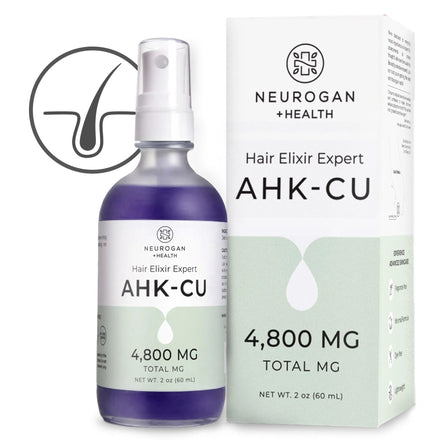
Graphic titled ‘Collagen and Hair Growth: The Role of GHK-Cu in Scalp Repair’ showing a close-up scalp image, hair follicle illustration, and the AHK-Cu logo.
Hair growth treatments tend to center on hormones, follicle cells, and the hair cycle itself. The scalp structure in which those follicles sit gets less attention. But it's something worth exploring because the quality of the dermis (the deeper layer of skin where follicles are anchored) directly affects how well follicles function and how long they stay healthy.
Collagen is the main structural protein in the dermis. It forms the scaffold that holds follicles in place, surrounds them with supportive tissue, and maintains the mechanical environment they depend on for normal cycling.
When collagen degrades, as it naturally does with age and is accelerated by inflammation, that scaffold weakens. Follicles become less securely anchored, the tissue around them becomes less organized, and hair quality tends to follow.
GHK-Cu, a naturally occurring copper-binding tripeptide found in human plasma, is one of the most studied cosmetic ingredients for collagen stimulation. It activates the fibroblasts that produce collagen, supports the enzymes that build stable collagen structures, and helps repair the scalp environment in ways that go beyond what most topical ingredients can claim.
what is GHK-Cu and How Does It Work?
GHK-Cu (copper tripeptide-1) is a tripeptide, a chain of three amino acids, bound to a copper ion. The three amino acids are glycine, histidine, and lysine. It occurs naturally in human plasma, saliva, and urine, and was first isolated by biochemist Dr. Loren Pickart in 1973 [1]. Its INCI name, the standardized label name used in cosmetic ingredient lists, is Copper Tripeptide-1.
What makes GHK-Cu unusual compared to most cosmetic peptides is the scope of its biological activity. It goes beyond one process — it appears to modulate a wide range of cellular activities.
Research by Pickart and colleagues has identified GHK-Cu as a regulator of gene expression, with the potential to influence hundreds of genes involved in skin repair, antioxidant defense, anti-inflammatory signaling, and tissue remodeling [2].
The copper ion is central to why it works.
Copper is a required cofactor for several important enzymes in the body. In the context of collagen and scalp health, two matters most: lysyl oxidase, which cross-links collagen fibers into stable, load-bearing structures, and superoxide dismutase (SOD), which neutralizes the free radicals that degrade both collagen and follicle cells.
The peptide structure of GHK-Cu allows it to deliver copper to tissues safely and in a form cells can actually use, which distinguishes it from applying copper-containing compounds directly.
GHK-Cu concentrations in human plasma are highest when we're young and decline steadily with age. At age 20, circulating GHK-Cu is estimated at around 200 nanograms per milliliter. By age 60, that figure has dropped to around 80 nanograms per milliliter [3]. That decline closely tracks the well-documented reductions in skin collagen density and hair quality observed over the same period.
How GHK-Cu Stimulates Collagen Production in the Scalp
Collagen is produced by fibroblasts, the specialized cells in the dermis responsible for manufacturing and maintaining the extracellular matrix (the protein scaffolding that surrounds and supports cells throughout the skin).
Fibroblasts produce collagen continuously, but their output slows with age and declines further under conditions of chronic inflammation, UV damage, or oxidative stress.
GHK-Cu stimulates fibroblast activity.
Studies have shown that fibroblasts exposed to GHK-Cu increase their production of collagen types I and III, the two forms most relevant to dermal structure and wound repair [1].
Type I collagen is the primary structural collagen in adult skin, providing tensile strength. Type III collagen is more abundant in younger skin and during tissue repair, contributing to flexibility and elasticity. GHK-Cu appears to stimulate both, which is part of why it's associated not just with more collagen but with better-organized collagen.
The Lysyl Oxidase Connection
Producing more collagen is only part of the equation. For collagen to be structurally useful, the individual fiber strands need to be cross-linked into stable bundles. That cross-linking is performed by lysyl oxidase, a copper-dependent enzyme. Without adequate copper, lysyl oxidase can't do its job properly, and the collagen produced is weaker and less organized than it should be.
This is where the copper in GHK-Cu becomes directly relevant to collagen quality, not just collagen quantity. By delivering bioavailable copper to fibroblast tissue, GHK-Cu supports lysyl oxidase activity and stimulates fibroblasts, increasing collagen production [4, 5].
Elastin and the Broader Matrix
GHK-Cu has also been shown to stimulate elastin production and help regulate the activity of matrix metalloproteinases (MMPs), the enzymes that break down the extracellular matrix.
Under inflammatory conditions, MMP activity increases, and the matrix degrades faster than it can be replaced. GHK-Cu may inhibit certain MMPs while simultaneously boosting the proteins that produce the matrix, effectively working on both the build and breakdown sides of the equation [6].
The Role of Collagen in Hair Follicle Health and Growth
Hair follicles are embedded in the dermis and surrounded on all sides by the extracellular matrix, the dense network of collagen fibers, elastin, and other structural proteins that make up most of the skin's volume. That matrix holds follicles in their correct positions, supports the capillary network that feeds them, and provides the mechanical environment for normal cycling.
Follicle Anchoring
Each hair follicle is anchored in the dermis by surrounding collagen fibers. Healthy, well-organized collagen keeps the follicle firmly seated at the correct depth in the skin.
When collagen breaks down, that anchoring weakens. Follicles can shift position relative to the surface, and the physical integrity of the follicle structure is reduced.
This is one of the reasons that aging skin, which has significantly lower collagen density, is linked with changes in hair quality even in people without androgenetic alopecia.
Perifollicular Fibrosis and Its Consequences
Chronic inflammation around hair follicles can produce perifollicular fibrosis, a process where disorganized, scar-like collagen replaces the normal matrix around the follicle.
This is structurally different from healthy collagen. It's stiffer, less organized, and constricts the follicle rather than supporting it. This leads to a physically compressed follicle that produces progressively thinner strands.
GHK-Cu's ability to stimulate organized collagen production and inhibit the inflammatory conditions that drive fibrosis makes it relevant to this process, though the evidence specifically on perifollicular fibrosis and GHK-Cu is more mechanistic than clinically established.
Capillary Support
The capillary network that delivers blood to active hair follicles runs through the extracellular matrix.
Collagen provides the structural support those tiny blood vessels need to maintain their integrity and stay open. When the matrix wears down, capillary density can decrease, and vessel walls become less stable, reducing the blood supply available to follicles during anagen.
Well-maintained collagen contributes to the vascular environment that follicles depend on.
GHK-Cu and scalp repair: Healing the Foundation for Hair Growth
Scalp repair is the process of restoring the scalp's structural integrity through collagen remodeling, inflammation reduction, and restoration of the follicular environment. It's not one event but an ongoing process, and in a healthy scalp, it runs continuously as part of normal tissue maintenance.
The problem is when the rate of damage outpaces the rate of repair, which is what happens under conditions of chronic inflammation, sustained oxidative stress, or the gradual cellular slowdown that comes with aging.
GHK-Cu has one of the better-documented wound healing profiles of any cosmetic ingredient.
Its role in wound repair was among the first things Pickart studied after isolating it, and the findings have been replicated across multiple tissue types. In wound healing research, GHK-Cu has been shown to accelerate the repair process by promoting cell migration into damaged areas, stimulating collagen synthesis, reducing inflammation, and supporting the formation of new blood vessels [7].
For the scalp specifically, these repair mechanisms translate directly into the conditions that support healthy follicle function.
A scalp that heals efficiently from the low-level daily damage of UV exposure, pollution, and normal cellular wear is a scalp that maintains the organized collagen matrix, stable blood supply, and low-inflammatory environment that follicles need to cycle normally.
This is the case for GHK-Cu as a foundation for hair health, rather than just a direct hair-growth treatment. It's not primarily stimulating follicle cells the way AHK-Cu does. It's maintaining and repairing the environment in which those cells live. That clarification is important for understanding what GHK-Cu is and isn't suited for.
How Collagen Supports the Hair Growth Cycle
The anagen phase is the active growth phase of the hair cycle, lasting two to seven years in healthy follicles.
During anagen, matrix cells at the base of the follicle divide rapidly to produce the hair shaft, while dermal papilla cells send growth signals that sustain the process. Both of those activities depend on the follicle being well-anchored, well-supplied with blood, and sitting in a supportive tissue environment.
Keratin is the main structural protein of the hair strand itself. It's different from collagen, which is the structural protein of the dermis rather than the strand, but the two are connected.
Adequate collagen in the scalp dermis supports the organized tissue environment in which keratin-producing matrix cells do their best work. A degraded dermal environment is associated with follicles that cycle less efficiently and produce weaker, less structurally intact strands.
Collagen is also directly involved in the hair follicle's physical structure. The follicle sheath, which surrounds and supports the growing strand, contains significant collagen content. Research has shown that collagen IV, a form of collagen found in basement membranes throughout the body, is present in the follicle's own internal structure and contributes to the integrity of the follicle during active growth [8].
When collagen density in the scalp dermis is well maintained, follicles have the physical and nutritional support to sustain longer anagen phases.
When it's reduced, particularly in the context of chronic inflammation or age-related decline, anagen tends to shorten, and the follicle's output diminishes. GHK-Cu's role in stimulating collagen synthesis addresses this at the level where the cycle's physical infrastructure is built and maintained.
The Science: Age-Related Decline of GHK-Cu and Collagen
GHK-Cu is one of the signals the body uses to maintain and repair collagen-producing tissue, so as its concentration falls, one of the mechanisms that keeps collagen production active falls with it.
Skin collagen content decreases by roughly one percent per year after the age of 20. By the time someone reaches their 50s or 60s, they may have lost 20 to 30 percent of their peak dermal collagen density. That loss shows up as thinner skin, reduced elasticity, and the progressive change in hair quality and density that many people experience from their 40s onward.
The GHK-Cu decline follows a similar curve.
Topical GHK-Cu application is a means of supplementing what the body no longer produces at the same level. By applying it directly to scalp tissue, you're providing the copper peptide signal that fibroblasts need to ramp up collagen synthesis in an area where endogenous GHK-Cu production has declined.
Whether that topical application produces the same result as the naturally occurring compound at youthful concentrations hasn't been definitively established, but the fibroblast stimulation research supports the principle.
GHK-Cu vs. Conventional Hair Growth Treatments
GHK-Cu sits in a different category from most hair loss treatments, and being clear about that is important for setting expectations.
| Treatment | Primary Mechanism | Target | Evidence Strength | Side Effects |
|---|---|---|---|---|
| GHK-Cu (Copper Tripeptide-1) | Collagen stimulation; scalp repair; anti-inflammatory; fibroblast activation | Scalp environment and dermis; indirect follicle support | Strong for collagen/skin repair; moderate for hair specifically | None reported at topical doses |
| AHK-Cu (Copper Tripeptide-3) | Dermal papilla cell stimulation; TGF-beta-1 reduction; apoptosis inhibition | Hair follicle cells directly | Small but targeted cell studies + one human trial | None reported |
| Minoxidil | Vasodilation; increased scalp blood flow; possible anagen extension | Blood vessels and follicle cycling | Decades of randomized clinical trials; FDA-approved | Initial shedding phase; scalp irritation possible |
| Finasteride | DHT blocking via 5-alpha reductase inhibition | Hormonal pathway; protects follicles from DHT | Decades of randomized clinical trials; FDA-approved | Sexual side effects reported in some users; systemic hormonal effects |
| PRP (platelet-rich plasma) | Growth factor delivery (PDGF, TGF-beta, IGF-1) to dermis | Follicle environment and repair | Moderate; growing clinical evidence | Injection site reactions; requires professional administration |
The key distinction for GHK-Cu is that it's primarily a scalp repair and maintenance ingredient rather than a direct hair growth stimulant. It doesn't have the clinical trial depth of minoxidil or finasteride for hair loss specifically. It doesn't directly stimulate dermal papilla cells the way AHK-Cu does.
What it does do is maintain and rebuild the dermal environment that follicles depend on, and it does that better than almost any other cosmetic ingredient available.
For someone whose hair concerns involve scalp quality, collagen loss, or chronic inflammation rather than acute androgenetic alopecia, GHK-Cu is more directly relevant. For someone with significant pattern hair loss, it's best understood as a supportive addition to a routine that also includes more direct interventions.
The combination of GHK-Cu and AHK-Cu is genuinely complementary for hair use: GHK-Cu repairs and maintains the scalp environment, while AHK-Cu targets the follicle cells within that environment.
How to Use GHK-Cu for Scalp Health
GHK-Cu for scalp use is best delivered through a leave-on serum applied directly to the scalp rather than through a rinse-off product.
Leave-on formulations allow enough contact time for the peptide to penetrate through the outer skin layer into the dermis, where fibroblasts are located. Shampoos and conditioners that contain GHK-Cu have too brief a contact time to be the primary delivery vehicle, though they can supplement a serum routine.
Concentration and Formulation
Effective GHK-Cu concentrations in published research range from around 0.1 to 1 percent in topical formulations.
Products that list GHK-Cu prominently in the ingredient list, ideally with a stated concentration, are preferable to products where it appears near the bottom, which often indicates trace amounts insufficient for meaningful fibroblast stimulation. The compound is stable in formulations with a pH between 4 and 7.
Frequency and Timing
Once or twice daily application is standard for copper peptide scalp serums.
Consistency over time matters more than any individual application. Because GHK-Cu's effects on collagen production work through fibroblast activation, which requires time for cells to produce and organize new collagen, the timeline for visible changes is months rather than weeks.
Reduced scalp sensitivity or improved scalp texture may become noticeable sooner, within four to eight weeks, but structural changes to the dermal matrix take longer to accumulate.
Ingredient Compatibility
GHK-Cu degrades in a strongly acidic environment.
Vitamin C in ascorbic acid form, typically formulated at pH 2.5 to 3.5, should be applied as a separate step. High-concentration AHAs and BHAs are similarly incompatible in the same application.
Niacinamide, hyaluronic acid, and most peptide serums are fine to use alongside GHK-Cu. If pairing with AHK-Cu, which is common in hair-focused formulations, they can be applied in the same step without concern.
microneedling Compatibility
GHK-Cu is one of the more commonly used topicals in conjunction with scalp microneedling because its molecular size allows it to take advantage of the temporary micro-channels that needling creates.
Applied immediately after a microneedling session, GHK-Cu can reach fibroblasts at concentrations substantially higher than those achievable through topical application alone through intact skin.
If you're incorporating microneedling, a professional practitioner can advise on appropriate needle depth for scalp applications (typically 0.5 to 1.5 millimeters) and post-needling application protocol.
Why the Scalp's Foundation Matters
Hair grows from follicles, but follicles grow from the scalp. The quality of the tissue those follicles are embedded in — its collagen density, its inflammatory status, its blood supply, and its structural organization — all feed directly into how well follicles cycle and how long they stay healthy. GHK-Cu works on that foundation.
It stimulates fibroblasts to produce more collagen. It supports lysyl oxidase, ensuring collagen remains structurally sound. It inhibits the enzymes that break down the matrix. It calms the inflammation that drives both matrix degradation and follicle disruption. And it does all of this while delivering copper, the trace mineral the scalp needs for antioxidant defense and enzymatic activity, in a bioavailable form that cells can use.
The research supporting GHK-Cu's collagen-stimulating activity is well established by cosmetic ingredient standards. Direct evidence on hair growth outcomes is more limited, which is why expectations should be calibrated accordingly. Used as a foundation for scalp health alongside more directly follicle-targeted ingredients, GHK-Cu is one of the more mechanistically grounded options available.
References
- Pickart, L., Vasquez-Soltero, J. M., & Margolina, A. (2015). GHK peptide as a natural modulator of multiple cellular pathways in skin regeneration. BioMed Research International, 2015(1), 648108.
- Pickart, L., Vasquez-Soltero, J. M., & Margolina, A. (2014). GHK and DNA: resetting the human genome to health. BioMed Research International, 2014(1), 151479.
- Dou, Y., Lee, A., Zhu, L., Morton, J., & Ladiges, W. (2020). The potential of GHK as an anti-aging peptide. Aging Pathobiology and Therapeutics, 2(1), 58.
- Rucker, R. B., Kosonen, T., Clegg, M. S., Mitchell, A. E., Rucker, B. R., Uriu-Hare, J. Y., & Keen, C. L. (1998). Copper, lysyl oxidase, and extracellular matrix protein cross-linking. The American Journal of Clinical Nutrition, 67(5), 996S–1002S.
- Dahl, S. L., Rucker, R. B., & Niklason, L. E. (2005). Effects of copper and cross-linking on the extracellular matrix of tissue-engineered arteries. Cell Transplantation, 14(6), 367–374.
- Badenhorst, T., Svirskis, D., Merrilees, M., Bolke, L., & Wu, Z. (2016). Effects of GHK-Cu on MMP and TIMP expression, collagen and elastin production, and facial wrinkle parameters. Journal of Aging Science, 4(3), 166.
- Pickart, L., & Margolina, A. (2008). The human tripeptide GHK-Cu in prevention of oxidative stress and degenerative conditions of aging: revival of a neglected topic. Current Aging Science, 1(3), 193–200.
- Messenger, A. G., Elliott, K., Temple, A., & Randall, V. A. (1991). Expression of basement membrane proteins and interstitial collagens in dermal papillae of human hair follicles. Journal of Investigative Dermatology, 96(1), 93–97.