Graphic titled ‘AHK-Cu vs Monoxidil: A Comparison for Hair Loss’ with blue and gold liquid droplet illustrations and the AHK-Cu logo
Minoxidil is the most widely used topical hair loss treatment in the world.
AHK-Cu is a newer copper peptide that's been a focus in the hair growth space, particularly among people looking for something without minoxidil's side-effect profile.
They're not direct substitutes for each other. They work through different mechanisms, have very different clinical research behind them, and are suited to somewhat different situations.
This article covers both ingredients honestly — the mechanisms, the research, the side effects, the practical considerations, and how to think about using them together or choosing between them.
what is AHK-Cu?
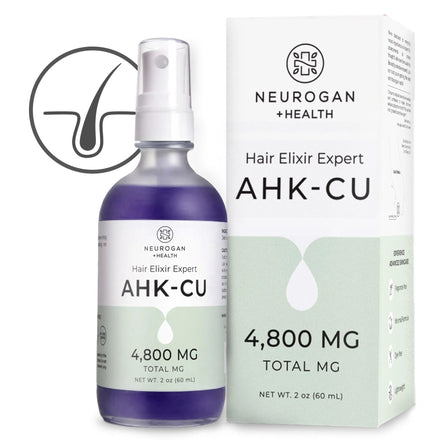
AHK‑Cu stands for alanine‑histidine‑lysine copper, i.e., a tripeptide of alanine, histidine, and lysine bound to a copper ion.
It's a synthetic copper‑binding tripeptide, often described as a lab‑designed analog of GHK‑Cu with alanine substituted for glycine.
It was engineered specifically to target hair follicle stimulation and was first studied in that context in 2007 by researchers at Seoul National University [1].
AHK-Cu is closely related to GHK-Cu (Copper Tripeptide-1), the naturally occurring copper peptide with a long research history in skin repair. The difference is a single amino acid at position one: GHK-Cu starts with glycine, AHK-Cu starts with alanine.
That substitution is thought to shift the peptide's affinity more specifically toward hair follicle cells, rather than toward the broader tissue-repair profile of GHK-Cu.
It's a cosmetic ingredient, not a drug.
It doesn't require a prescription, doesn't go through FDA drug approval, and cannot legally be marketed as a treatment for hair loss.
What it can do, based on available research, is support follicle health at the cellular level through mechanisms distinct from those of other commonly used hair-loss treatments.
What Is Minoxidil?
Minoxidil is an FDA-approved topical hair loss treatment, the only topical with full regulatory approval for androgenetic alopecia.
It was originally developed as an oral blood pressure medication in the 1970s and was found to produce hair growth as a side effect. Topical formulations were subsequently developed and approved for hair loss use: first for men (1988) and later for women (1991).
It's available over the counter in concentrations of 2% and 5%, most commonly as a liquid or foam applied directly to the scalp. Prescription-strength oral minoxidil is also now used for hair loss at low doses, though the topical form remains the standard first-line recommendation.
Minoxidil works primarily by widening blood vessels in the scalp, a process called vasodilation, which increases blood flow to hair follicles. It also appears to extend the anagen phase, the active growth phase of the hair cycle, though the exact mechanism underlying this effect is still being studied. In use, existing hairs grow larger, shedding slows, and, in some users, new growth appears in areas that had thinned.
How AHK-Cu Works: Mechanism of Action
AHK-Cu works by stimulating dermal papilla cells, the specialized cells at the base of each hair follicle that control hair growth and cycling.
These cells act as the follicle's command center. They receive signals from the body and instruct the follicle when to grow, rest, and shed. When dermal papilla cell populations decline or lose function, hair production weakens.
Dermal Papilla Cell Stimulation and Apoptosis Inhibition
The 2007 Pyo study found statistically significant dermal papilla cell proliferation in human follicle cultures treated with AHK-Cu (p < 0.001) [1].
The same study found that AHK-Cu reduced markers of apoptosis (programmed cell death) in those cells: a 42.7% reduction in cleaved caspase-3 and a 77.5% reduction in cleaved PARP, both at p < 0.05. More dermal papilla cells, alive and active for longer, means a stronger, more sustained growth signal.
VEGF Upregulation
AHK-Cu has been associated with increased VEGF (vascular endothelial growth factor) production, a signaling protein that promotes blood vessel formation and is key for nutrient delivery to active hair follicles.
Growing follicles in anagen have high metabolic demands, and a better blood supply around the follicle helps sustain the growth phase.
This mechanism overlaps with how minoxidil benefits follicles, though via a distinct route: minoxidil widens existing vessels, whereas VEGF upregulation promotes the formation of new ones.
TGF-beta-1 Reduction and Anagen Extension
The Lee 2016 study found that AHK-Cu was associated with decreased TGF-beta-1 secretion in scalp fibroblasts [2].
TGF-beta-1 is the cytokine that signals follicles to stop growing and enter the resting phase. Reducing it delays that transition, keeping follicles in anagen longer.
Oxidative Stress Reduction
AHK-Cu upregulates superoxide dismutase (SOD) production, an antioxidant enzyme that neutralizes free radicals in scalp tissue.
Reducing oxidative stress is important for hair because high free radical activity upregulates the enzyme that converts testosterone to DHT locally, amplifying follicle damage beyond what circulating DHT alone would cause.
AHK-Cu doesn't block DHT directly, but by reducing the oxidative stress that drives excess local DHT production, it may lower the effective DHT burden on the follicle.
Some research suggests copper peptides may also have modest direct effects on DHT activity at the follicle level, but this is less established than the antioxidant mechanism, and human clinical data on this specific point are limited [1].
How Minoxidil Works: Mechanism of Action
Minoxidil's effect comes from vasodilation. It opens potassium channels in smooth muscle cells lining blood vessel walls, causing the vessels to relax and dilate.
In the scalp, that widening increases blood flow to hair follicles, delivering more oxygen and nutrients to support active growth.
Beyond the vascular effect, minoxidil appears to extend the anagen phase of the hair cycle [3].
The exact mechanism isn't fully mapped out, but it's thought to involve minoxidil sulfate (the active metabolite produced when minoxidil is converted in the body) interacting with follicle cells to delay the transition from anagen to the resting phase.
This is why minoxidil both reduces shedding and, in some users, produces visible new growth in areas where follicles are still active.
Minoxidil Limitations
It's worth mentioning what minoxidil doesn't do.
It doesn't block DHT, the hormone that drives follicular miniaturization, the gradual shrinking of hair follicles that causes hair to become thinner and shorter over time.
DHT-related miniaturization continues in the background even with minoxidil use, which is why stopping minoxidil typically results in hair loss returning to where it would have been without treatment.
Minoxidil maintains and supports follicles, but it doesn't address the hormonal driver causing them to shrink.
AHK-Cu vs. Minoxidil: clinical evidence and Research
This is the section where the comparison becomes most lopsided, and it's important to be straightforward about it.
| AHK-Cu | Minoxidil | |
|---|---|---|
| Regulatory status | Cosmetic ingredient (no drug approval) | FDA-approved for androgenetic alopecia (OTC) |
| Foundational study | Pyo et al. 2007: ex vivo follicle culture, n=240 follicles from 10 donors | Multiple RCTs since the 1980s; hundreds of studies |
| Best human trial | Lee et al. 2016: randomized, n=45, +52–71 new hairs over 6 months | Multiple large RCTs; consistent evidence across thousands of patients |
| Mechanism confirmed in humans? | Partially (hair count data exists; cellular mechanisms from lab studies) | Yes; well-established in clinical literature |
| Long-term data | Not available | Available; decades of real-world use data |
| Independent replication | Limited | Extensive; multiple independent research groups |
Minoxidil's evidence base is decades deep. Large, randomized, placebo-controlled trials have been conducted in both men and women across multiple countries, and the consistent finding is that minoxidil slows or stops hair loss and produces visible regrowth in a large proportion of users. That's the standard against which everything else in the hair loss space gets measured.
AHK-Cu's evidence base is small but not negligible.
The Pyo 2007 ex vivo study provides specific, measurable, statistically significant data on follicle elongation and dermal papilla cell behavior.
The Lee 2016 randomized trial gives a human hair count outcome. These are real findings. What's missing is the scale, independence, and replication that would put AHK-Cu on the same evidentiary footing.
Anyone comparing the two should go into it with that gap clearly understood.
AHK-Cu is a promising ingredient with a mechanistically credible rationale and early supporting evidence. Minoxidil is a proven, FDA-approved treatment. Those are different things.
Side Effects: AHK-Cu vs. Minoxidil
The side effect profiles of the two ingredients are quite different, and for some people, that difference is the deciding factor.
AHK-Cu Side Effects
No significant side effects have been reported in published research on AHK-Cu at typical topical concentrations.
There are no hormonal effects, no reported sexual side effects, and no shedding phase.
The blue-green tint that some copper peptide serums display is from the copper ion itself, not a dye, and it washes off normally. At very high concentrations, copper can theoretically act as a pro-oxidant, but well-formulated products are designed to remain within the safe and effective range.
Patch testing is always a good idea before applying any new topical to the full scalp, particularly for people with sensitive skin.
Minoxidil Side Effects
Minoxidil has a more notable side effect profile.
The most common is an initial shedding phase in the first four to eight weeks of use, when follicles in late telogen are pushed into a new cycle and shed simultaneously before new growth begins. This is normal and expected, but it's alarming for people who don't know to anticipate it.
Scalp irritation, dryness, and contact dermatitis occur in a subset of users, more commonly with the liquid formulation (which contains propylene glycol) than with foam.
Some women report unwanted facial hair growth when using topical minoxidil, particularly if it drips onto the face during application.
Oral minoxidil, even at the low doses used for hair loss, carries a slightly different risk profile, including fluid retention, heart palpitations in rare cases, and unwanted body hair growth. These effects are rare at low oral doses but warrant mention.
Systemic absorption from topical minoxidil is generally considered low, but it's not zero.
For most healthy adults, it's clinically insignificant, but people with cardiovascular conditions should discuss topical minoxidil use with a physician.
Application, Cost, and Availability
| AHK-Cu | Minoxidil | |
|---|---|---|
| Form | Topical scalp serum or spray | Topical liquid, foam, or low-dose oral tablet |
| Application frequency | Once or twice daily | Twice daily (topical); once daily (oral) |
| Prescription required | No | No (topical OTC); Yes (oral) |
| Typical cost | Variable; $30–$100+ for specialty peptide serums | $30–$80/month for generic topical minoxidil |
| Widely available | Growing availability; primarily online and specialty retailers | Very widely available; pharmacies, supermarkets, online |
| Continue if you stop? | Effects likely diminish; no established reversal data | Hair loss typically returns within months of stopping |
Generic minoxidil is one of the most affordable hair loss interventions available, with monthly costs well under $30 for most users.
Copper peptide serums with meaningful AHK-Cu concentrations tend to cost significantly more, and the market is less standardized, meaning product quality varies considerably between brands.
If you're evaluating copper peptide products, looking for formulations that disclose their AHK-Cu concentration, ideally in the 0.01 to 1 percent range, is a useful quality filter.
Can You Use AHK-Cu and Minoxidil Together?
Yes, and there's a good biological rationale for doing so.
The two ingredients work through different mechanisms with very little overlap.
Minoxidil works through vasodilation, widening existing blood vessels to improve scalp blood flow. AHK-Cu works through stimulation of dermal papilla cells, reduction of TGF-beta-1, upregulation of VEGF (which builds new vessels rather than widening existing ones), and inhibition of apoptosis. They're addressing different parts of the same problem, which is what makes them complementary.
There are no known interactions between AHK-Cu and minoxidil.
They can be applied in the same routine without concern, though some users prefer to apply them in separate steps to give each product time to contact the scalp before layering the next.
If you're using a minoxidil foam or liquid first, allowing it to dry before applying a copper peptide serum is a sensible approach.
For people who are already using minoxidil and seeing stable results, adding AHK-Cu as a complementary layer is a low-risk decision.
For people who are new to treating hair loss and haven't tried minoxidil, starting with the more evidence-supported treatment first and adding copper peptides later is probably the more logical sequence.
Which Hair Loss Treatment Is Right for You?
The honest answer is that these two ingredients aren't really in competition. They're suited to different contexts and can serve different roles in the same routine.
Start with Minoxidil If:
You have androgenetic alopecia (pattern hair loss) and are looking for a treatment with proven clinical efficacy. Minoxidil is the most evidence-supported topical option available without a prescription.
If you haven't tried it and significant hair loss is your primary concern, it's the logical starting point. The evidence gap between minoxidil and AHK-Cu is real and shouldn't be papered over.
Consider AHK-Cu If:
You want a non-hormonal, low-side-effect approach to supporting follicle health as part of a broader routine.
AHK-Cu makes sense as a complementary ingredient for someone already using minoxidil or finasteride who wants to add cellular support.
It also makes sense for someone with early or mild thinning who prefers to start with lower-intensity interventions, or for someone who can't or won't use minoxidil for medical or personal reasons.
For women in particular, who have fewer well-evidenced options than men, copper peptides represent a gentler exploratory option alongside other approaches.
Consider Both If…
Your goal is comprehensive scalp and follicle health, and you want to address the vascular, cellular, and inflammatory aspects of hair loss simultaneously.
The combination of minoxidil's established vascular and anagen-extension effects with AHK-Cu's support for dermal papilla cells, VEGF upregulation, and anti-apoptotic activity covers more biological ground than either alone.
There are no safety concerns with using both, and for people serious about long-term hair health, the combination is one of the more well-reasoned non-prescription approaches available.
References
- Pyo, H. K., Yoo, H. G., Won, C. H., Lee, S. H., Kang, Y. J., Eun, H. C., Cho, K. H., & Kim, K. H. (2007). The effect of tripeptide-copper complex on human hair growth in vitro. Archives of Pharmacal Research, 30(7), 834–839.
- Lee, W. J., Lee, S. M., Choe, Y. B., & Ahn, K. J. (2016). Effects of copper-tripeptide on hair growth in a mouse model and in human dermal papilla cells. Annals of Dermatology, 28(4), 413–419.
- Messenger, A. G., & Rundegren, J. (2004). Minoxidil: mechanisms of action on hair growth. British Journal of Dermatology, 150(2), 186–194.