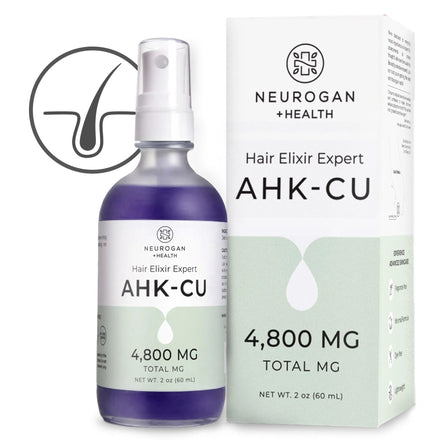
Graphic titled ‘AHK-Cu vs Finasteride: Peptides vs DHT Blockers for Hair Loss’ featuring an AHK-Cu hair and scalp serum bottle and the AHK-Cu logo.
Finasteride goes after the hormone that causes follicles to shrink. AHK-Cu works at the level of the follicle cell to directly support growth. One is a prescription drug with decades of clinical data. The other is a cosmetic ingredient with a smaller but targeted body of research.
They don't belong in the same category, and comparing them directly requires being honest about that.
Finasteride's clinical track record is in a different league from AHK-Cu's. But the side effect profile that comes with finasteride is also in a different category, and for a significant number of people, hormonal intervention isn't an option or isn't something they want. That's the real reason this comparison matters.
what is AHK-Cu? (copper tripeptide-3 Explained)
AHK-Cu stands for Alanine-Histidine-Lysine Copper, a short-chain copper-binding peptide complex known by the INCI name Copper Tripeptide-3. It's made up of three amino acids, alanine, histidine, and lysine, bonded to a copper ion.
It was synthetically engineered to target hair-follicle biology and was first studied in this context in a 2007 paper from Seoul National University [1].
AHK-Cu is closely related to GHK-Cu (Copper Tripeptide-1), which is a naturally occurring copper peptide with a longer research history in skin repair.
The structural difference is a single amino acid substitution at position 1: glycine in GHK-Cu and alanine in AHK-Cu, which is thought to shift the peptide's biological affinity more specifically toward hair follicle cells rather than the broader tissue-repair profile of GHK-Cu.
Because AHK-Cu is a cosmetic ingredient rather than a pharmaceutical, it's not FDA-approved for the treatment of hair loss and cannot legally be marketed as a hair loss treatment.
The research supports the idea that it may stimulate dermal papilla cell proliferation, extend the active growth phase of the hair cycle, and support the scalp environment in ways relevant to hair health.
What Is Finasteride? (How DHT Blockers Work)
Finasteride is an FDA-approved prescription medication sold under brand names Propecia (1 mg, for hair loss) and Proscar (5 mg, for benign prostatic hyperplasia).
It was approved for male pattern hair loss in 1997 and is one of only two FDA-approved treatments for androgenetic alopecia in men, alongside minoxidil.
Finasteride is a 5-alpha reductase inhibitor. It works by blocking the enzyme that converts testosterone into DHT (dihydrotestosterone), a potent androgen hormone and the primary hormonal driver of androgenetic alopecia. At the standard 1 mg dose for hair loss, finasteride reduces circulating DHT levels by approximately 70 percent [2].
It requires a prescription, is taken orally once daily, and produces systemic hormonal effects throughout the body, not just in the scalp. That systemic reach is both its strength, as it reduces DHT wherever it is causing follicle damage, and the source of its most-discussed limitations.
How DHT Causes Hair Loss: The Hormonal Pathway
DHT, or dihydrotestosterone, is produced when testosterone is converted by the enzyme 5-alpha reductase. It's a normal hormone with important roles in male development, but in people with a genetic sensitivity to it in their scalp follicles, it becomes the driver of progressive hair loss.
The mechanism works like this: DHT binds to androgen receptors on dermal papilla cells, the specialized fibroblasts at the base of each hair follicle that regulate hair growth cycling and follicle health.
When DHT repeatedly binds to those receptors, the dermal papilla cells gradually shrink and lose function. As they do, the growth signals they send to the follicle get weaker. Each successive hair cycle becomes shorter. The follicle produces a progressively thinner, shorter, lighter strand. This is follicular miniaturization, the process by which DHT causes hair follicles to shrink until they can no longer produce visible hair.
Over the years, advances in miniaturization have occurred in specific scalp regions — the temples, the crown, and the frontal hairline in men, and the part line and crown in women. The follicles at the back and sides of the scalp are largely resistant to DHT, which is why pattern hair loss affects those areas last.
Both finasteride and AHK-Cu are relevant to this process, but from completely different angles.
Finasteride reduces DHT, which causes miniaturization in the first place. AHK-Cu works to support the follicle cells that miniaturization has been damaging, without touching DHT at all.
AHK-Cu Mechanism of Action: How Peptides Stimulate Hair Growth
AHK-Cu is not a DHT blocker.
This is the most important thing to understand about what it does and doesn't do. It does not inhibit 5-alpha reductase. It does not reduce circulating DHT levels. It does not affect testosterone or any other hormone systemically. Making that claim about AHK-Cu would be inaccurate.
Based on available research, AHK-Cu appears to stimulate hair growth through a cellular pathway that operates independently of DHT.
Dermal Papilla Cell Stimulation
The 2007 Pyo study found statistically significant dermal papilla cell proliferation in human follicle cultures treated with AHK-Cu (p < 0.001) [1]. More active dermal papilla cells mean stronger growth signals reaching the rest of the follicle. The same study found that AHK-Cu extended follicle elongation in culture, a direct measure of sustained anagen activity.
Apoptosis Inhibition
AHK-Cu was associated with a 42.7% reduction in cleaved caspase-3 and a 77.5% reduction in cleaved PARP in treated dermal papilla cells, both of which are markers of apoptosis (programmed cell death), at p < 0.05 [1].
Keeping dermal papilla cells alive longer sustains the growth signal that DHT has been gradually eroding.
VEGF and Scalp Blood Flow
AHK-Cu has been associated with increased VEGF (vascular endothelial growth factor) production in skin fibroblasts [1].
VEGF promotes the formation of new blood vessels around active follicles, improving the delivery of oxygen and nutrients that active follicles depend on. This vascular support nourishes follicles through longer, healthier growth phases.
Finasteride Mechanism of Action: Blocking 5α-Reductase
Finasteride works upstream of everything AHK-Cu addresses.
Rather than supporting the cells that DHT has been damaging, it reduces the amount of DHT reaching those cells in the first place.
5-alpha reductase exists in two forms:
- Type I (found in skin, liver, and some scalp tissue)
- Type II (the dominant form in scalp hair follicles).
Finasteride selectively inhibits Type II 5-alpha reductase. By blocking this enzyme, it interrupts the conversion of testosterone to DHT in follicle tissue. Circulating DHT levels fall by roughly 70 percent at the 1 mg dose [3, 4].
With less DHT reaching androgen receptors, the miniaturization process slows or stops. Follicles that were producing progressively thinner strands could stabilize. In a subset of users, follicles that had miniaturized but hadn't yet become dormant may partially recover, producing slightly thicker strands than they were before treatment.
Finasteride doesn't repair the cellular damage that has already occurred. It removes the cause of ongoing damage. This means earlier treatment, while follicles still have dermal papilla cell populations, tends to produce better outcomes than treatment started after extensive miniaturization.
clinical evidence: AHK-Cu Research vs Finasteride Studies
The evidence gap here is big, and it's worth being clear about it.
| AHK-Cu | Finasteride | |
|---|---|---|
| Regulatory status | Cosmetic ingredient; no drug approval | FDA-approved prescription medication (1997) |
| Primary evidence | Pyo 2007 (ex vivo, n=240 follicles); Lee 2016 (randomized, n=45) | Multiple large Phase III RCTs; thousands of patients |
| Largest human trial | n=45 patients over 6 months (+52–71 new hairs) | Phase III trial: 1,553 men over 2 years; 48% showed hair count increase vs 7% placebo |
| Long-term data | Not available | 5-year and 10-year follow-up studies available |
| Independent replication | Limited | Extensively replicated across multiple countries |
| Works in women? | No established contraindication | Not approved for women; contraindicated in those of childbearing age |
| Evidence for mechanism | Cell studies with specific measurable outcomes | Clinical outcomes and serum DHT measurements in large cohorts |
Finasteride's pivotal trial, a two-year randomized placebo-controlled study of 1,553 men with androgenetic alopecia, found that 83 percent of finasteride users maintained or increased their hair count compared to 28 percent in the placebo group [5]. Five-year data showed sustained benefit with continued use. That's the kind of evidence base that earns regulatory approval.
AHK-Cu's best human data is the Lee 2016 randomized study of 45 patients, which found 52 to 71 new hairs over six months [2]. That's a real finding in real people and it matters, but the sample size, follow-up duration, and level of independent replication are in a different category from finasteride's evidence base.
Any honest comparison has to acknowledge this gap rather than smooth over it.
Side Effects Comparison: Peptides vs DHT Blockers
This is where the two compounds also differ — one is a medication, which produces a more dramatic effect, but it also means the stakes are higher.
AHK-Cu Side Effects
No significant side effects have been reported in published research on AHK-Cu at topical concentrations.
There are no hormonal effects, no sexual side effects, and no systemic changes of any kind. It's typically applied topically to the scalp and does not enter systemic circulation.
The blue-green tint some copper peptide serums display is the copper ion itself, not a dye, and it's cosmetically inert. We always recommend patch testing before full scalp application, especially for people with sensitive skin or known metal sensitivities.
Finasteride Side Effects
Finasteride's side effect profile has received a lot of attention in both the medical literature and the broader public conversation.
The most discussed effects are sexual in nature: a subset of users report reduced libido, erectile dysfunction, and ejaculatory changes in approximately two to four percent of users in clinical trials, though real-world reporting and patient advocacy groups suggest this number may undercount persistent cases [6].
Post-finasteride syndrome, a term used to describe persistent sexual, neurological, and psychological side effects that continue after discontinuation, is an area of active research and genuine medical debate.
The FDA has required labeling updates to include warnings about persistent side effects, acknowledging that they occur in a subset of users beyond the treatment period.
Other reported effects include breast tenderness or enlargement in a small percentage of male users, mood changes, and a rare association with high-grade prostate cancer in some analyses (this finding remains debated in the literature).
For most men who use finasteride, it is well-tolerated and the side effects are either absent or mild and reversible.
But the hormonal mechanism means it carries a category of risk that AHK-Cu simply does not.
| Side Effect Category | AHK-Cu | Finasteride |
|---|---|---|
| Sexual side effects | None reported | Reported in ~2–4% in trials; persistent cases documented |
| Hormonal disruption | None | Reduces systemic DHT by ~70%; affects hormone balance |
| Post-discontinuation effects | No data; no mechanism for persistence | Post-finasteride syndrome reported in a subset of users |
| Scalp/skin reactions | Rare; patch test recommended | Not typically topical; oral form |
| Safe in pregnancy/women | No established contraindication | Contraindicated; teratogenic in male fetuses |
| Initial shedding phase | Not reported | Not typical (unlike minoxidil) |
Who Should Use AHK-Cu vs Finasteride?
Please note that this is just a general overview of these two compounds and we're not prescribing a treatment for hair loss. You'll also have to consult with a doctor to get a prescription for finasteride, as it's not something you can get over the counter.
Finasteride Is Most Appropriate For:
Men with androgenetic alopecia who are comfortable with a prescription hormonal medication and want the most clinically proven non-surgical option available.
Finasteride has the strongest evidence base of any oral hair loss treatment for men.
It works best when started before miniaturization has set in, and it requires ongoing use to maintain results.
It's not approved for women and is contraindicated in women of childbearing age due to the risk of causing genital malformations in a male fetus if the person were to become pregnant.
AHK-Cu Is Most Appropriate For:
Anyone looking for a non-hormonal, topical approach to supporting follicle health. This includes women with pattern hair loss or diffuse thinning, for whom finasteride is not a viable option.
It also includes men who want to address hair health proactively without systemic hormonal intervention, people who have experienced finasteride side effects and are looking for alternatives, and people using finasteride who want to add complementary cellular support.
AHK-Cu is most useful as part of a broader approach rather than as a standalone treatment for significant androgenetic alopecia. The evidence for it as a sole intervention for meaningful hair loss is thinner than what would justify using it in place of proven treatments.
Can You Use AHK-Cu and Finasteride Together?
Yes. There are no known pharmacological interactions between topical AHK-Cu and oral finasteride. They work through completely separate mechanisms on different biological targets.
Finasteride reduces systemic DHT by blocking the enzyme that produces it. AHK-Cu is applied topically to the scalp and works at the follicle cell level: stimulating dermal papilla cell proliferation, reducing TGF-beta-1 to extend anagen, upregulating VEGF for better blood supply, and reducing oxidative stress. None of those pathways interact with finasteride's mechanism.
Using both means you're reducing the hormonal driver of miniaturization (finasteride) while also supporting the follicle cells and growth environment that miniaturization has been degrading (AHK-Cu). That combination addresses the problem from two angles at the same time.
You'd take finasteride as directed by your prescribing physician, and apply AHK-Cu scalp serum once or twice daily as part of your topical routine. No timing separation between the two is required.
AHK-Cu vs GHK-Cu: Which Copper Peptide Is Better for Hair?
For hair specifically, AHK-Cu has the more targeted evidence. For scalp health broadly, GHK-Cu's broader tissue repair and anti-inflammatory profile is more established. Many well-formulated copper peptide scalp serums include both, because they address complementary aspects of the follicle environment: GHK-Cu maintains the surrounding scalp tissue; AHK-Cu targets the follicle cells within it.
Neither is the obviously superior choice for hair across all situations. If you're choosing one, AHK-Cu has the more follicle-specific rationale. If you can use both, the combination covers more ground.
References
- Pyo, H. K., Yoo, H. G., Won, C. H., Lee, S. H., Kang, Y. J., Eun, H. C., Cho, K. H., & Kim, K. H. (2007). The effect of tripeptide-copper complex on human hair growth in vitro. Archives of Pharmacal Research, 30(7), 834–839.
- Salisbury, B., Leslie, S., & Tadi, P. (2024). 5α-reductase inhibitors. StatPearls.
- Kaufman, K. D., & Dawber, R. P. (1999). Finasteride, a Type 2 5α-reductase inhibitor, in the treatment of men with androgenetic alopecia. Expert Opinion on Investigational Drugs, 8(4), 403–415.
- Zito, P. M., Bistas, K. G., & Syed, K. (2018). Finasteride.
- Kaufman, K. D., Olsen, E. A., Whiting, D., Savin, R., DeVillez, R., Bergfeld, W., et al. (1998). Finasteride in the treatment of men with androgenetic alopecia. Journal of the American Academy of Dermatology, 39(4), 578–589.
- Mysore, V. (2012). Finasteride and sexual side effects. Indian Dermatology Online Journal, 3(1), 62–65.