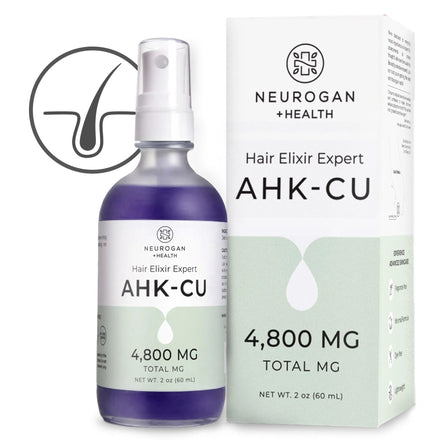
AHK-Cu Hair Elixir Expert serum bottle (4,800 mg) beside a wooden comb
Copper peptides have been studied in tissue repair research since the 1970s, but the hair growth angle is a more recent development.
The interest makes sense once you understand what copper actually does in the body: it's an essential trace mineral involved in collagen production, antioxidant defense, and the activity of enzymes that maintain and repair tissue. Binding copper to a short amino acid chain, or peptide, makes it easier to deliver that activity to specific tissues in a more targeted way.
The two copper peptides that come up most often in hair research are GHK-Cu (copper tripeptide-1) and AHK-Cu (Copper Tripeptide-3).
They share a copper ion and two of their three amino acids, but they were designed for different purposes and have different research profiles. This guide covers how copper peptides work, what the evidence actually shows, how they compare to more established hair loss treatments, and how to use them in practice.
The science here is real and worth understanding. The claims made about it in product marketing are often not. The goal is to help you tell the difference.
what are copper peptides?
Copper peptides are short chains of amino acids, typically two or three, bonded to a copper(II) ion. They're a class of bioactive compounds found naturally in human plasma and other body fluids, and also produced synthetically for cosmetic and research applications.
The biological interest comes from two things working together.
Copper (Cu²⁺) is an essential trace mineral the body depends on for collagen synthesis (via an enzyme called lysyl oxidase), antioxidant defense (via superoxide dismutase), and cellular energy production. But copper, in its raw ionic form, doesn't readily enter tissue in large amounts. The peptide acts as a stabilizer and delivery vehicle, allowing copper to reach specific cell types in a bioavailable form.
GHK‑Cu, also known as Copper Tripeptide‑1, is the most extensively studied copper peptide. It is a naturally occurring tripeptide found in human plasma and was first isolated from human albumin by biochemist Loren Pickart in 1973 [1].
Its research history covers skin repair, collagen and elastin synthesis, wound healing, and anti-inflammatory signaling across decades of published work.
AHK-Cu, or Copper Tripeptide-3, is a synthetic copper peptide engineered specifically for hair follicle applications.
It shares histidine and lysine with GHK-Cu but substitutes alanine for glycine at the first position of the amino acid chain. That structural change appears to shift its biological affinity more narrowly toward follicle tissue. It was first studied for hair growth by Pyo et al. at Seoul National University in 2007 [2].
Both peptides carry a natural blue-green tint from the copper ion itself. That color in a serum is simply the peptide complex, not a dye, so a good quality product shouldn’t stain your skin.
Understanding the Hair Growth Cycle
Before getting into how copper peptides affect hair, it helps to understand what they're acting on.
Every hair follicle on your scalp cycles through three phases independently. The anagen phase is the active growth phase, when the follicle is producing a new strand. It lasts anywhere from two to seven years depending on genetics, and it's the phase that determines how long your hair can grow.
The catagen phase is a brief two-to-three-week transition period during which the follicle shrinks and detaches from its blood supply, signaling the end of active growth. The telogen phase is the resting phase, lasting roughly three months, when the strand is dormant and eventually shed.
In a healthy scalp, roughly 85 to 90 percent of follicles are in anagen at any given time. Problems appear when follicles spend less time in anagen and more time in telogen, or when they progressively shrink with each cycle, a process called follicle miniaturization.
Miniaturization is the hallmark of androgenetic alopecia, the most common form of hair loss in both men and women. It's driven by genetic sensitivity to DHT (dihydrotestosterone), a hormone derived from testosterone that binds to follicle receptors and triggers a gradual shrinking process. Each cycle, the follicle produces a slightly thinner, shorter strand. Eventually it produces nothing at all.
Copper peptides are thought to counteract this by supporting follicle cell health and growth cycle duration, not by blocking DHT. That distinction is important for understanding both their potential and their limits.
How Copper Peptides Promote Hair Growth: Five Mechanisms
The proposed mechanisms for copper peptide activity in hair follicles are grounded in cell biology. Most of the direct evidence comes from in vitro studies and small clinical trials rather than large randomized controlled trials, so the content below reflects that. Here's what the current research suggests.
Dermal Papilla Cell Stimulation
Dermal papilla cells are specialized fibroblasts that sit at the base of each hair follicle. Think of them as the command center: they receive and transmit the growth signals that determine whether a follicle stays in anagen or shifts toward telogen. When dermal papilla cell populations decline, follicle activity slows.
The 2007 Pyo et al. study found that AHK-Cu treatment of cultured dermal papilla cells was associated with increased cell proliferation markers [2]. The same study observed reduced activity of apoptosis markers, meaning the copper peptide appeared to support cell survival alongside cell division. More active, longer-lived dermal papilla cells are better positioned to sustain the growth signals the follicle depends on.
Anagen Phase Extension
AHK-Cu's proposed effect on TGF-beta-1 is important. TGF-beta-1 is a cytokine, a signaling protein, that tells the follicle to stop growing and move toward regression. Research in 2016 found evidence that AHK-Cu may decrease TGF-beta-1 secretion in follicle cells [2]. If that signal is quieted, the follicle may remain in anagen longer. More time in anagen means longer, potentially thicker hair strands, and a better ratio of actively growing follicles on the scalp.
VEGF-Driven Scalp Blood Flow
VEGF, or vascular endothelial growth factor, is a protein that stimulates the formation of new blood vessels.
Active hair follicles are metabolically demanding: they need a steady supply of oxygen and nutrients to sustain rapid cell division during anagen. Research has associated copper peptide treatment with upregulation of VEGF in follicle tissue [2].
Better vascularization around the follicle supports that demand. This mechanism overlaps with how minoxidil works, though the pathways are different: minoxidil acts as a vasodilator, while copper peptides appear to stimulate vessel formation through growth factor signaling.
Anti-Inflammatory Scalp Environment
Chronic low-grade inflammation around the hair follicle contributes to follicle regression and has been implicated in several forms of hair loss.
Copper plays a role in antioxidant defense through superoxide dismutase, an enzyme that neutralizes free radicals in tissue. Oxidative stress, the cellular damage that results when free radical production outpaces antioxidant activity, is also associated with excess DHT synthesis in scalp tissue.
GHK-Cu in particular has a documented anti-inflammatory profile across multiple tissue types, observed in both cell studies and preclinical research [2]. Reducing that inflammatory load around follicles may create a more hospitable environment for sustained growth, though the direct causal link between GHK-Cu's anti-inflammatory activity and hair growth outcomes hasn't been established cleanly in clinical trials.
Anti-Apoptotic Follicle Protection
The fifth mechanism ties directly to the Pyo 2007 data. That study found that AHK-Cu treatment was associated with a 42.7% reduction in caspase-3 activity and a 77.5% reduction in PARP cleavage in treated dermal papilla cells [2]. Both caspase-3 and PARP are markers of apoptosis, programmed cell death. Keeping follicle cells alive longer sustains the cellular population that drives growth signaling. This is relevant in androgenetic alopecia, where follicle cell populations are thought to decline as miniaturization progresses.
The Two Types of Copper Peptides for Hair
GHK-Cu and AHK-Cu are the two copper peptides with meaningful research relevant to hair. Here's how they differ in origin, mechanism focus, and research depth.
GHK-Cu's strength is its breadth.
Its research base extends well beyond hair into skin and tissue repair, and its anti-inflammatory and antioxidant properties have been documented across multiple study types. A 2008 study by Pickart et al. observed follicle enlargement as a secondary finding in wound healing research, suggesting GHK-Cu's tissue repair activity extends to follicle tissue [1].
AHK-Cu's strength is its specificity.
Its research, though smaller in volume, is more directly targeted at the cellular mechanisms underlying hair growth. The structural change from glycine to alanine appears to shift its receptor affinity toward follicle tissue, and the Pyo and Lee studies provide measurable data points on follicle-specific outcomes.
Many scalp serums include both, reasoning that they may act on complementary aspects of follicle biology. Whether that combination is meaningfully better than either alone hasn't been tested in controlled trials.
What Does the Research Say?
The evidence is encouraging and grounded in real biology, but it's not yet at the level of large randomized controlled trials.
The Pyo et al. 2007 study at Seoul National University is the foundational AHK-Cu paper. Researchers treated cultured human dermal papilla cells with AHK-Cu and measured changes in cell proliferation and apoptosis markers.
They found statistically significant reductions in caspase-3 and PARP activity, the 42.7% and 77.5% figures respectively, alongside increased cell proliferation [2]. The limitation is that cell studies don't always translate to the same outcomes in living tissue.
GHK‑Cu has preclinical and cosmetic skin data, and reviews state that copper peptides can “increase hair growth and thickness” and “enlarge hair follicle size,” but these effects are mostly inferred from animal, ex vivo, or non‑scalp cosmetic studies [3].
Pickart's 2008 wound healing research observed follicle enlargement in areas treated with GHK-Cu, which supported the hypothesis that the peptide's tissue repair activity extends to follicle structures [1].
The gap in the literature is a large, independent, placebo-controlled trial specifically on copper peptides for androgenetic alopecia. That study doesn't exist yet. The current evidence is preclinical or small-scale, which is worth knowing before building expectations around these ingredients.
Copper Peptides vs. Minoxidil vs. Finasteride
These three approaches work through different mechanisms, which means they're not straightforward substitutes for each other.
Minoxidil's primary mechanism is vasodilation: it widens blood vessels in the scalp to increase blood flow to follicles.
It also appears to extend the anagen phase through a separate pathway involving potassium channel activity. It's the most widely used over-the-counter hair loss treatment and has decades of randomized trial data behind it. The main drawbacks are the initial shedding phase that some users experience when starting treatment, and the fact that results typically reverse if treatment is discontinued.
Finasteride is a prescription oral medication that blocks the enzyme responsible for converting testosterone into DHT. It addresses the hormonal driver of androgenetic alopecia directly and has strong clinical evidence in men. The concern for some users is its side effect profile, which includes reported hormonal and sexual effects in a subset of patients. It's not approved for use in women of childbearing potential.
Copper peptides work through the follicle nourishment pathway: supporting dermal papilla cell health, growth factor signaling, and vascular supply rather than acting on hormones or blood vessel tone directly. They don't have the clinical evidence volume that minoxidil and finasteride do. But they also don't carry hormonal side effect risk, and they don't trigger a shedding phase.
For many people, the practical question isn't which one to choose. It's whether copper peptides are worth adding as a complementary layer to a routine that already includes more established options. That's a reasonable question, and the answer is probably yes for people who tolerate topical applications well and are consistent about it.
How to Use Copper Peptides for Hair Growth
Copper peptides are used almost exclusively as leave-on topical formulations for hair applications. The most effective format is a scalp serum or spray applied directly to a clean, dry scalp, not a shampoo or conditioner that gets rinsed off quickly.
Contact time matters. The peptide needs time to interact with follicle tissue, and rinse-off products don't provide it. After applying, work the serum into the scalp with fingertips to encourage absorption and avoid heavy layering with other products immediately after.
A realistic timeline looks something like this: some users notice reduced shedding within the first four weeks, which may reflect the anti-inflammatory and anti-apoptotic activity.
Visible new growth, if it occurs, typically appears around the two-to-three-month mark. Changes in density take five to six months of consistent daily use, at minimum. Hair cycling is slow, and any ingredient working through follicle biology will reflect that.
Microneedling, which creates micro-channels in the scalp dermis using fine needles, is increasingly paired with copper peptide serums. The idea is that micro-channels allow deeper peptide penetration into the tissue where dermal papilla cells are located. This combination is used in clinical settings and has shown up in hair restoration research, though it hasn't been studied rigorously enough as a combined protocol to make firm claims about additive benefit. If you're considering it, working with a practitioner rather than doing it unsupervised is the sensible approach.
Who May Benefit from Copper Peptides?
Copper peptides are most relevant for hair loss types where the follicle is still present and potentially functional. The mechanisms described above — dermal papilla cell support, anagen extension, improved vascular supply — all presuppose that there's a follicle to work with.
Androgenetic Alopecia
Androgenetic alopecia, or pattern hair loss, is the most studied application. Both men and women experience this form of hair loss, though the pattern differs: men typically see recession at the temples and thinning at the crown, while women more often see diffuse thinning across the top of the scalp. Because the mechanism involves follicle miniaturization rather than follicle death, copper peptides' ability to support follicle cell health is directly relevant.
Earlier intervention, before miniaturization is far advanced, is likely where these compounds have the most to offer.
telogen effluvium, a temporary form of diffuse shedding triggered by stress, illness, significant hormonal changes, or nutritional deficiency, involves follicles prematurely entering the telogen phase. Copper peptides' proposed effect on reducing premature telogen entry may be relevant here, and their anti-inflammatory activity addresses one of the contributing factors. This is a plausible application, though it's less studied than androgenetic alopecia.
Copper peptides aren’t likely to be helpful in cases of scarring alopecia, where the follicle itself has been permanently damaged or destroyed, or in cases of complete baldness where follicles are no longer present. The nourishment pathway requires a functioning follicle to nourish.
Age-Related Thinning
Age-related thinning that isn't driven by androgenetic alopecia specifically may also respond to the follicle nourishment approach, since reduced scalp circulation and cellular activity are part of how hair changes with age.
Post-Pregnancy Hair Loss
Post-pregnancy hair loss, which is a form of telogen effluvium triggered by the hormonal shift after delivery, often resolves on its own as hormone levels normalize. Copper peptides could support the recovery period, though in most cases the follicles recover without intervention given time.
What to Avoid When Using Copper Peptides
Copper peptides are sensitive to pH. The copper-peptide bond is stable in a neutral to slightly acidic environment but can degrade in strongly acidic conditions. This has practical implications for what you apply alongside them.
Vitamin C in the form of ascorbic acid (L-ascorbic acid) is the main ingredient to avoid layering with copper peptides in the same application step. Ascorbic acid has a low pH, typically around 2.5 to 3.5 in effective formulations, which can destabilize the copper-peptide complex and may also cause a copper-vitamin C interaction that generates free radicals rather than neutralizing them. If you use both, separate them into different routine steps or different times of day.
Strong AHAs (alpha-hydroxy acids like glycolic and lactic acid) and BHAs (beta-hydroxy acids like salicylic acid) also create a low-pH environment on the scalp. Using them in the same step as copper peptides may reduce the peptide's stability. Alternating them, for example AHAs on one day and copper peptides on another, is a reasonable approach if you use both.
Retinoids, which work at a different pH range, are generally considered incompatible with copper peptides in the same application step. The interaction isn't as clearly defined as the vitamin C concern, but given that both are actives, there's little reason to layer them simultaneously when alternating is straightforward.
The general principle: copper peptides are best applied on a clean scalp, on their own, without mixing with other actives in the same step. If your routine includes multiple actives, stagger them across morning and evening applications or across different days.
The Takeaway
If you're starting from zero on hair loss, copper peptides alone are probably not your best opening move. Options with more clinical backing deserve to come first. But as a complementary layer added to a broader approach, or as a non-hormonal option for someone who can't or won't use DHT-blocking compounds, the follicle nourishment pathway that copper peptides work through is worth including.
Look for formulations that list either GHK-Cu (Copper Tripeptide-1) or AHK-Cu (Copper Tripeptide-3) transparently in the ingredient list, ideally with concentration information. Apply consistently to a clean scalp, keep them away from low-pH actives, and give it at least five to six months before drawing conclusions.
References
- Pickart, L., Vasquez-Soltero, J. M., & Margolina, A. (2012). The human tripeptide GHK‑Cu in prevention of oxidative stress and degenerative conditions of aging: implications for cognitive health. Oxidative Medicine and Cellular Longevity, 2012(1), 324832.
- Pyo, H. K., Yoo, H. G., Won, C. H., Lee, S. H., Kang, Y. J., Eun, H. C., Cho, K. H., & Kim, K. H. (2007). The effect of tripeptide-copper complex on human hair growth in vitro. Archives of Pharmacal Research, 30(7), 834–839. https://doi.org/10.1007/BF02978833
- Pickart, L., & Margolina, A. (2018). Regenerative and Protective Actions of the GHK-Cu Peptide in the Light of the New Gene Data. International Journal of Molecular Sciences, 19(7), 1987. https://doi.org/10.3390/ijms19071987