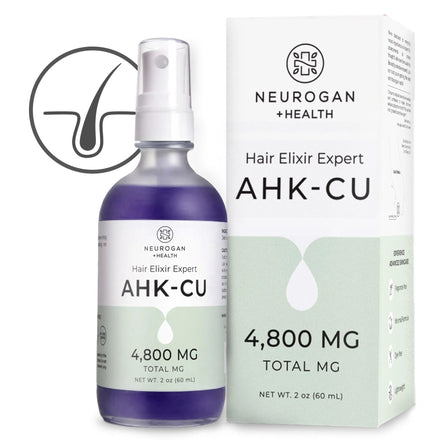
Graphic titled “What Is AHK-Cu? Guide to Copper Tripeptide-3 for Hair Growth” featuring a hand holding an AHK-Cu hair and scalp serum bottle.
If you've been researching hair loss solutions long enough, you've probably noticed a few ingredients cycling through the conversation. minoxidil. finasteride. biotin. And lately, copper peptides. AHK-Cu is one of the more specific names you'll see come up, often alongside GHK-Cu and marketed as a targeted option for hair follicle health.
The claim is interesting. Unlike some ingredients that entered the hair care space through extrapolation, AHK-Cu has a reasonably direct line of evidence linking it to hair follicle biology.
But 'interesting' and 'proven' are not the same thing, and the research here is early enough that it's worth being clear about what the science actually supports.
This guide covers what AHK-Cu is, how it's thought to work, what the research does and doesn't say, and how it fits into a realistic hair care approach.
What AHK-Cu Actually Is
AHK-Cu stands for alanine-histidine-lysine copper, a tripeptide bound to a copper ion.
A tripeptide is simply three amino acids linked together in sequence. In this case, the three amino acids are alanine, histidine, and lysine. The '-Cu' indicates that a copper ion is chelated, or attached, to the peptide chain.
Think of the peptide as a delivery vehicle and copper as the cargo.
The peptide structure helps copper enter tissue more targetedly than raw copper salts could on their own. This is the core principle behind most copper peptide formulations: copper is biologically important, but getting it where it needs to go, in a form cells can actually use, requires some help.
AHK-Cu is sometimes called copper tripeptide-3, which is its INCI name (the standardized naming system used in cosmetic ingredient labeling). You may also see it referred to as copper peptide AHK or simply listed as 'tripeptide-3' on product labels.
It's unique from GHK-Cu (copper tripeptide-1), which is the better-studied copper peptide in the skin and hair space.
AHK-Cu has a narrower research base, but some of what exists is specifically relevant to hair follicle activity, which is why it tends to appear more often in hair care formulations than in skin products.
How AHK-Cu Is Thought to Work
Copper plays a role in several enzymatic processes in the body, including melanin production, collagen synthesis, and the activity of enzymes that help maintain and repair tissue. In hair follicle biology specifically, copper is involved in the function of an enzyme called lysyl oxidase, which helps maintain the structural integrity of hair follicle tissue [1].
There are a few mechanisms by which AHK-Cu is thought to support hair growth, though it's worth noting that much of this mechanistic work comes from cell-based or animal studies rather than large-scale human clinical trials.
Follicle Stimulation via IGF-1
IGF‑1 is a natural signal in the body that tells hair cells when to grow, stay alive, and enter the active growth phase of the hair cycle (called anagen).
In lab studies on hair grown in dishes, AHK‑Cu has been shown to help hair strands grow longer and to support the cells at the base of the hair (dermal papilla cells) as they grow and survive, and some scientists think copper peptides like AHK‑Cu may work partly by altering signals such as IGF‑1 [2].
If future studies show that AHK‑Cu really changes IGF‑1 signals in real human scalp skin, that could help keep hairs in the anagen, or active growth, phase for longer.
Follicle Size and Miniaturization
In androgenetic alopecia (the most common type of pattern hair loss), hair loss mainly happens because of follicle miniaturization, meaning the hair follicles slowly get smaller and start making thinner, shorter hairs.
Early studies have examined whether copper peptides might help slow or reverse this by improving follicle size and overall scalp health, but most of this evidence comes from lab experiments and small human studies rather than large clinical trials.
For AHK‑Cu in particular, lab work suggests it can support dermal papilla cells at the base of the follicle — the cells that control hair growth — by promoting their growth and survival in culture, which, in theory, could help them resist miniaturization [3].
Anti-Inflammatory Effects
Chronic low-grade inflammation around the hair follicle is a contributing factor in several forms of hair loss. Copper has known antioxidant and anti-inflammatory properties through its role in superoxide dismutase, an enzyme that neutralizes free radicals. The peptide-bound form may help direct that activity toward follicle tissue, though this is largely inferred from copper's broader biology rather than AHK-Cu-specific research [4].
Wnt Pathway Involvement
Some research has looked at the Wnt signaling pathway, which plays a central role in hair follicle development and cycling. Preliminary cell studies suggest copper peptides may modulate activity in this pathway, which could theoretically support follicle cycling [5].
What the Research Actually Shows
The honest read on AHK-Cu is that the research base is small. It's not nonexistent, but it's nowhere near the volume or quality you'd want before drawing firm conclusions.
A small clinical study in the cosmetic dermatology literature compared a copper peptide called GHK‑Cu with topical minoxidil for supporting hair growth.
In that study, the group using the copper peptide showed improvements in hair parameters (including follicle size) that were in a similar range to the minoxidil group, and they appeared to have fewer reported side effects (although the study was small, not definitive, and conducted on animals) [6].
AHK‑Cu wasn’t the main compound tested, but results like these have helped drive broader interest in copper peptides in general as potential agents for hair loss.
There's currently no large, randomized, placebo-controlled trial specifically on AHK-Cu for hair loss in humans. The existing studies are mostly small, some are industry-funded, and the majority focus on GHK-Cu rather than AHK-Cu directly. That context matters when evaluating the strength of claims made in product marketing.
AHK-Cu vs. GHK-Cu: What's the Difference?
This is a common point of confusion, and it's worth addressing directly.
GHK-Cu (glycine-histidine-lysine copper, also called copper tripeptide-1) is the more extensively studied of the two. It has a larger body of research on skin remodeling, wound healing, and hair follicle support. If you're looking for a copper peptide with more evidence behind it, GHK-Cu is where that evidence lives.
AHK-Cu differs in its amino acid sequence, which changes how it interacts with receptors and tissue. Some research suggests AHK-Cu may have a greater affinity for hair follicle cells than GHK-Cu, though this has not been conclusively established in human studies. The idea is that each copper peptide may have slightly different biological targets depending on its structure, similar to how different keys fit different locks.
In practice, many hair care products combine both peptides, reasoning that they may act through complementary pathways. Whether that combination provides a benefit over either compound alone hasn't been rigorously tested.
How AHK-Cu Is Used
AHK-Cu is used almost exclusively topically in hair care formulations. There is no established oral form for hair applications, and injectable use falls outside the scope of most consumer products (and carries different risk considerations that would require clinical supervision).
Below is a general overview of how AHK-Cu typically appears in formulations, based on available product and ingredient data. These are not standardized guidelines, as there is no regulatory consensus on the dosage for this compound.
|
Format |
Typical Concentration |
Application Frequency |
|
Scalp serum |
0.01%–1% |
Once or twice daily |
|
Leave-in treatment |
0.01%–0.5% |
Once daily, post-wash |
|
Shampoo/conditioner |
Trace amounts |
Regular washing routine |
|
Topical peptide blend |
Combined with GHK-Cu |
Per product instructions |
Most formulations are designed to be applied directly to the scalp, not rinsed off.
Leave-on products allow more contact time with the follicle, which is generally considered more effective for peptide delivery than rinse-off formulations, where contact time is limited.
What AHK-Cu Is Not
Before spending money on this ingredient, it's worth being clear about a few things AHK-Cu is not.
It is not a replacement for minoxidil or finasteride. Those compounds have decades of clinical data and regulatory approval behind them. AHK-Cu does not. If hair loss is a significant concern and you have not yet tried first-line options, copper peptides should not be your starting point.
It’s not a treatment for hair loss. Supplements and cosmetic ingredients cannot legally claim to treat, prevent, or cure conditions like androgenetic alopecia. AHK-Cu may support scalp and follicle health as a complementary approach, but it doesn’t have an evidence base sufficient to be considered a hair loss treatment.
It’s also not fast-acting. Hair cycling is slow. Any ingredient working through follicle biology will take months to produce visible results, if it produces them at all.
Marketing that implies rapid regrowth is overstating what the science can support.
Who Might Consider It
AHK-Cu is a reasonable addition to a hair care routine for someone who is already addressing the basics: consistent scalp health, adequate nutrition, and ideally some level of guidance from a dermatologist if hair loss is significant.
It may be worth exploring topical peptides as a complementary approach if you've already addressed more foundational factors, if you're sensitive to conventional topical treatments and are looking for alternatives to consider alongside medical advice, or if you're interested in topical peptides as a complementary approach.
It's less likely to be the right focus if you're in the early stages of addressing hair loss and haven't yet tried options with stronger evidence behind them, or if you're expecting dramatic results from a single ingredient.
A Realistic Takeaway
AHK-Cu is a copper-bound tripeptide with a plausible biological rationale for supporting hair follicle health. The mechanisms researchers have proposed, including IGF-1 upregulation and dermal papilla cell support, are grounded in real follicle biology. The evidence, however, is early-stage, concentrated in cell studies and small trials, and mostly indirect.
That doesn't make it a bad ingredient. It makes it an ingredient worth watching as research develops, and one that may offer modest complementary benefits as part of a broader scalp health routine. What the current research doesn't support are the bold efficacy claims that tend to accompany copper peptides in product marketing.
If you're curious about copper peptides for hair health, look for formulations with transparent concentrations, no misleading efficacy claims, and, ideally, some published data supporting the product. And if hair loss is a significant concern, talking to a dermatologist before building a peptide-heavy routine is worth the step.
References
-
Hayashi, K., Cao, T., Passmore, H., Jourdan-Le Saux, C., Fogelgren, B., Khan, S., ... & Csiszar, K. (2004). Progressive hair loss and myocardial degeneration in rough coat mice: reduced lysyl oxidase-like (LOXL) in the skin and heart. Journal of investigative dermatology, 123(5), 864-871.
-
Madaan, A., Verma, R., Singh, A. T., & Jaggi, M. (2018). Review of hair follicle dermal papilla cells as in vitro screening model for hair growth. International journal of cosmetic science, 40(5), 429-450.
-
Pyo, H. K., Yoo, H. G., Won, C. H., Lee, S. H., Kang, Y. J., Eun, H. C., ... & Kim, K. H. (2007). The effect of tripeptide-copper complex on human hair growth in vitro. Archives of pharmacal research, 30(7), 834-839.
-
Altobelli, G. G., Van Noorden, S., Balato, A., & Cimini, V. (2020). Copper/zinc superoxide dismutase in human skin: current knowledge. Frontiers in Medicine, 7, 537401.
-
Choi, B. Y. (2020). Targeting Wnt/β-catenin pathway for developing therapies for hair loss. International journal of molecular sciences, 21(14), 4915.
-
Uno, H., & Kurata, S. (1993). Chemical agents and peptides affect hair growth. Journal of investigative dermatology, 101(1), S143-S147.