hair thinning after 40 is not one thing. It's a convergence of several biological processes — hormonal changes, declining collagen, reduced scalp blood flow, accumulated oxidative damage, and slower cellular renewal. Each of these unfolds on its own timeline, and for most people they arrive together, compounding each other.
Copper peptides — specifically GHK-Cu and AHK-Cu — address several of these mechanisms directly. That's why they show up in formulas aimed at age-related hair quality loss and thinning, not just androgenetic alopecia.
Why Hair Thins After 40: The Biology
Hormonal Changes
In men: testosterone conversion to DHT continues, while total androgen production may decline slightly with age. DHT accumulation over decades drives progressive follicle miniaturization in genetically susceptible individuals.In women: estrogen declines through perimenopause and menopause (typically 45-55). Estrogen has protective effects on follicles — it prolongs anagen and counteracts some androgen effects. Its decline can unmask underlying AGA and accelerate diffuse thinning.
Collagen Decline
Collagen production peaks in the mid-20s and declines about 1% per year after that [1]. The scalp's dermal layer loses density, reducing the structural support around follicles. GHK-Cu plasma concentrations also decline with age — from approximately 200 ng/mL in young adults to 80 ng/mL in older adults [2] — parallel to the collagen decline.Reduced Scalp Blood Flow
Aging reduces capillary density and blood flow efficiency in scalp tissue. The follicle, which requires continuous oxygen and nutrient delivery to sustain active growth, is affected. VEGF (vascular endothelial growth factor) production declines with age.Oxidative Stress Accumulation
Mitochondrial function declines with age, and reactive oxygen species (ROS) accumulate. Oxidative stress in the hair follicle microenvironment accelerates the anagen-catagen transition and contributes to the graying and miniaturization seen with age.Slower Cellular Renewal
The rate of cell turnover throughout the body slows with age, including in the follicle bulb. The dermal papilla cells that control the anagen-catagen decision become less proliferative.What GHK-Cu Addresses in Aging Hair
GHK-Cu is a naturally occurring copper tripeptide whose plasma levels track age-related changes in skin and hair condition. It activates over 4,000 repair-related genes, many of which become underactive with aging [3]. Relevant to aging hair:| Mechanism | Relevance to Aging Scalp |
|---|---|
| collagen synthesis upregulation | Partially restores the dermal matrix that supports follicles |
| MMP-1 inhibition | Reduces degradation of existing scalp collagen |
| VEGF upregulation | Supports capillary density around follicles |
| SOD/catalase induction | Reduces oxidative damage to follicle cells |
| Anti-inflammatory | Reduces chronic scalp inflammation linked to AGA progression |
What AHK-Cu Addresses in Aging Hair
AHK-Cu (copper tripeptide-3) works directly on follicle cells in ways that are particularly relevant to the declining cellular activity of aging follicles:- DP cell proliferation: Stimulates the dermal papilla cells that become less active with age [4]
- TGF-beta-1 suppression: Reduces the catagen-inducing signal that leads to shortened anagen phases
- Anti-apoptotic effects: Reduces programmed cell death in follicle cells (~43-78% reduction in cell studies)
- VEGF: Complements GHK-Cu's vascular support
Together, GHK-Cu and AHK-Cu address both the scaffolding layer (collagen, capillaries, oxidative protection) and the cellular control layer (DP proliferation, anagen extension, anti-apoptosis).
What Minoxidil and finasteride Don't Cover in Aging Hair
| What Goes Wrong | Minoxidil | Finasteride | Copper Peptides |
|---|---|---|---|
| DHT-driven follicle miniaturization | No | Yes | No |
| Reduced scalp blood flow | Yes (vasodilation) | No | Partially (VEGF) |
| Shortened anagen phase | Yes (mechanism) | No | Yes (TGF-β1 suppression) |
| Declining collagen/dermal matrix | No | No | Yes (GHK-Cu) |
| Oxidative stress accumulation | No | No | Yes (SOD/catalase) |
| DP cell proliferation decline | No | No | Yes (AHK-Cu) |
| Chronic scalp inflammation | No | No | Partially (GHK-Cu) |
The table explains why copper peptides are complementary rather than competitive with conventional treatments — they address mechanisms those drugs don't.
Hair Thinning After 40 in Women vs Men
Men
Male pattern baldness (AGA) is DHT-driven and genetic. The hormonal picture doesn't change dramatically at 40 in the way it does for women. What changes is the cumulative effect of decades of androgen exposure, plus the natural decline in scalp collagen and blood flow.Copper peptides are an appropriate complement to minoxidil or finasteride in this context.
Women
The transition into perimenopause and menopause (typically beginning in the mid-40s) is when many women notice accelerated hair thinning. Estrogen's protective role declines, collagen loss accelerates, and any underlying AGA becomes more visible.Women after 40 often cannot or prefer not to use DHT-blocking medications. Copper peptides offer a non-hormonal mechanism that addresses several of the underlying processes. Minoxidil (2% or 5%) remains first-line for women with AGA.
How to Use Copper Peptides for Aging Hair After 40
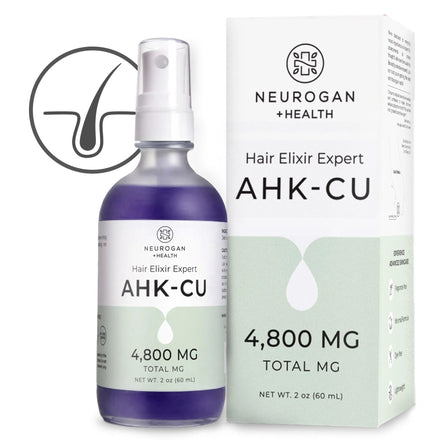
The application protocol is the same as for any copper peptide use: daily leave-on application to the affected scalp areas, massaged in and left on.At 40+, a dual-peptide formula containing both GHK-Cu and AHK-Cu addresses more of the aging-specific mechanisms than either alone. The 1:1 ratio in the Neurogan Health formulation targets both the follicle cell layer (AHK-Cu) and the scalp structural and vascular layer (GHK-Cu).
The timeline for visible results is six months, consistent with what's reported in clinical studies.
What to Expect
Copper peptides won't reverse decades of follicle miniaturization in established AGA. What they can do:- Support remaining follicles that haven't yet been permanently lost
- Maintain scalp tissue quality as the collagen and vascular environment degrades
- Complement prescription treatments by addressing mechanisms those treatments don't cover
For someone in their 40s noticing early to moderate thinning, this is a realistic scope of benefit.
Lifestyle Factors That Amplify Copper Peptide Benefit After 40
- Protein intake: Hair is made of protein. Adequate dietary protein supports keratin production.
- Iron levels: Iron deficiency worsens hair loss; more common in women postmenopause if they had heavy periods.
- Sleep: Growth hormone is released in deep sleep; relevant to cellular renewal rates in aging tissue.
- Scalp massage: Four minutes daily has shown measurable impact on hair shaft thickness [5].
References
- Varani, J., et al. (2006). Decreased collagen production in chronologically aged skin. American journal of pathology, 168(6), 1861-1868.
- Dou, Y., Lee, A., Zhu, L., Morton, J., & Ladiges, W. (2020). The potential of GHK as an anti-aging peptide. Aging pathobiology and therapeutics, 2(1), 58.
- Pickart, L., & Margolina, A. (2018). Regenerative and protective actions of the GHK-Cu peptide in the light of the new gene data. International journal of molecular sciences, 19(7), 1987.
- Pyo, H. K., et al. (2007). The effect of tripeptide-copper complex on human hair growth in vitro. Archives of pharmacal research, 30(7), 834-839.
- Koyama, T., et al. (2016). Standardized scalp massage results in increased hair thickness. Eplasty, 16, e8.