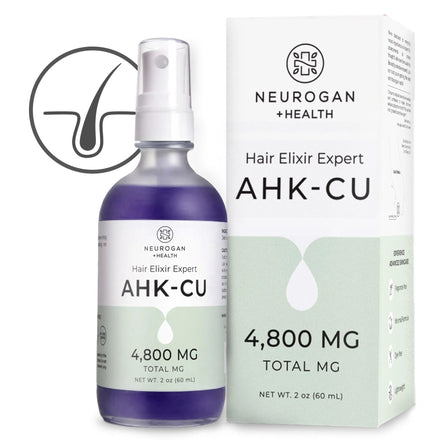
Thinning hair is not one problem with one solution. It's a spectrum — from early diffuse shedding that most people will see at some point, to progressive follicular miniaturization that eventually produces visible baldness. Where on that spectrum you fall changes what's likely to help.
Copper peptides, specifically AHK-Cu and GHK-Cu, have a plausible role in early to moderate thinning. They're not a replacement for proven medical treatments, and they won't regrow hair in follicles that have already been destroyed. But they address several mechanisms that conventional treatments miss.
Understanding Thinning Hair: Why It Happens
Hair thinning occurs when the balance between hair production and hair loss shifts. The most common reasons: androgenetic alopecia (AGA) — Genetic sensitivity of follicles to DHT causes progressive miniaturization of the follicle, producing progressively thinner, shorter hairs before eventually shutting down entirely. telogen effluvium — A systemic stressor (illness, nutritional deficiency, surgery, childbirth, psychological shock) causes a bulk shift of follicles from anagen to telogen. The resulting shedding is alarming but usually self-limiting. Age-related thinning — Separate from AGA, aging reduces scalp collagen density, blood flow, and mitochondrial function in follicle cells. Both men and women experience some degree of this. Nutritional deficiencies — Iron, vitamin D, zinc, and protein deficiencies can impair hair growth. These are correctable causes.what are copper peptides? GHK-Cu and AHK-Cu Explained
Copper peptides are short amino acid chains chelated to copper ions. Two forms are relevant to hair: GHK-Cu (copper tripeptide-1) — Naturally occurring in human plasma. First studied by Dr. Loren Pickart in 1973 [1]. Stimulates collagen synthesis, reduces inflammation, and activates repair genes. Plasma concentrations decline with age. AHK-Cu (Copper Tripeptide-3) — A synthetic analog with one amino acid difference from GHK-Cu. Studied specifically for hair follicle stimulation. Targets dermal papilla cells, which control the anagen-catagen decision.How Copper Peptides Target Hair Thinning Specifically
Dermal Papilla Cell Stimulation
The dermal papilla is the cluster of mesenchymal cells at the base of the follicle that orchestrate hair growth. AHK-Cu has been shown to stimulate proliferation of these cells in human follicle cultures [2].Anagen Extension via TGF-beta-1 Suppression
TGF-beta-1 is one of the key signals that triggers the transition from anagen (growth) to catagen (regression). AHK-Cu suppresses TGF-beta-1 in dermal papilla cells, effectively helping keep follicles in the growth phase longer.VEGF Upregulation
Thinning hair is associated with reduced vascular supply to the follicle. AHK-Cu upregulates VEGF (vascular endothelial growth factor) in dermal fibroblasts, promoting new capillary formation around follicles. This mechanism parallels what minoxidil does through a different pathway.Anti-Apoptotic Effect
AHK-Cu reduces programmed cell death (apoptosis) in follicle cells. In cell studies, this appears as ~43% reduction in caspase-3 activity and ~78% reduction in cleaved PARP.Scalp Collagen (GHK-Cu)
The scalp's collagen matrix provides mechanical support to the follicle. GHK-Cu upregulates collagen synthesis and inhibits the enzymes that degrade it. Declining scalp collagen with age is one factor in age-related thinning.scalp inflammation
Chronic low-grade scalp inflammation is associated with progressive AGA. GHK-Cu has anti-inflammatory properties that may reduce this background inflammation.clinical evidence for Copper Peptides in Hair Thinning
| Study | Subjects | Duration | Key Finding |
|---|---|---|---|
| Pyo et al. (2007) | Human follicle cultures | In vitro | AHK-Cu produced statistically significant follicle elongation and DP cell proliferation |
| Lee et al. (2016) | 45 patients (RCT) | 6 months | 52-71 new hairs in treated areas at 6 months |
| Oun et al. (1999) | Patients with AGA | 12 months | Copper peptide complex showed improved hair growth vs. comparison groups |
Copper Peptides vs Other Hair Thinning Treatments
| Treatment | Mechanism | Evidence | Safety | FDA Status |
|---|---|---|---|---|
| AHK-Cu | DP cell stimulation, VEGF, TGF-β1 suppression | Early trials + cell data | Excellent | Not approved |
| Minoxidil | Vasodilation, anagen extension | Extensive RCT data | Good (scalp irritation possible) | Approved (OTC) |
| Finasteride | DHT reduction via 5-alpha reductase inhibition | Extensive RCT data | Sexual side effects (some users) | Approved (Rx, men) |
| GHK-Cu | Collagen, anti-inflammatory, wound healing | Small trials + cell data | Excellent | Not approved |
| LLLT | Mitochondrial stimulation via red light | Moderate trial data | Excellent | Cleared (devices) |
| Microneedling | Mechanical wound healing, DP stimulation | Growing RCT data | Good (technique-dependent) | Not a drug; cleared devices |
Is AHK-Cu Right for You? Who Benefits Most
Best candidates:- Early thinning — more viable follicles to work with
- Age-related diffuse thinning alongside or instead of AGA
- Postpartum telogen effluvium (supportive role)
- People complementing minoxidil or finasteride
- People who prefer non-hormonal options
- Women who can't use finasteride/dutasteride
- Advanced AGA with extensive follicle destruction
- Scarring alopecias (follicles permanently damaged)
- Thinning from active untreated nutritional deficiency (fix the deficiency first)
- Anyone expecting results in weeks rather than months
How to Use Copper Peptides for Thinning Hair
Apply a leave-on copper peptide serum to the affected areas of the scalp twice daily. Consistency over months is more important than any single application. The evaluation window is six months.For best results alongside AHK-Cu:
- Use minoxidil if indicated
- Ensure adequate protein, iron, and vitamin D
- Practice regular scalp massage
- Consider microneedling once weekly to improve peptide penetration
Realistic Timeline
| Month | Expected Progress |
|---|---|
| 1-2 | Possible reduction in daily shedding; no visible new growth yet |
| 2-3 | Fine baby hairs may begin appearing; scalp condition improves |
| 4-6 | Visible density improvement in responding users |
| 6+ | Assessment window; continued gains still possible |
The Bottom Line
Copper peptides — specifically AHK-Cu for follicle stimulation and GHK-Cu for scalp repair — are mechanistically strong, well-tolerated, and have early clinical evidence supporting their use for thinning hair.They are not a replacement for minoxidil or finasteride in the evidence hierarchy, but they address different parts of the biology and work safely alongside those treatments. For someone in the early stages of thinning who wants a well-rounded approach, they're a rational part of the protocol.
References
- Pickart, L., & Thaler, M. M. (1973). Tripeptide in human serum which prolongs survival of normal liver cells and stimulates growth in neoplastic liver. Nature: New biology, 243(124), 85-87.
- Pyo, H. K., et al. (2007). The effect of tripeptide-copper complex on human hair growth in vitro. Archives of pharmacal research, 30(7), 834-839.
- Lee, W. J., et al. (2016). Efficacy of a complex of 5-aminolevulinic acid and glycyl-histidyl-lysine peptide on hair growth. Annals of dermatology, 28(4), 438-443.