Graphic titled “AHK-Cu for Crown Thinning: Targeting the Most Common Problem Area” showing the back of a person’s head with visible crown thinning, with the AHK~Cu logo at the bottom.
Crown thinning has a particular quality that makes it frustrating to treat. It's often the last thing you notice and the first thing everyone else sees. The hair at the sides and front can look fine from the front, while the vertex is thinning in the background. By the time it becomes obvious, the process has usually been underway for years.
AHK-Cu is worth looking into in this situation because the crown is driven by the same cellular mechanism that copper peptides are designed to address, just concentrated in a specific location.
Whether AHK-Cu can help depends on how far along the process is and what else you're doing alongside it.
what is AHK-Cu?
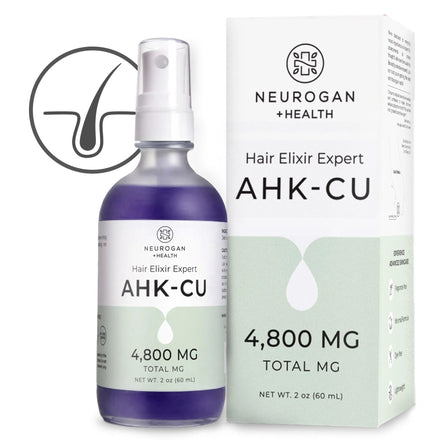
AHK-Cu (Alanine-Histidine-Lysine Copper, also known as Copper Tripeptide-3) is a synthetic copper peptide engineered specifically to stimulate hair follicle activity.
It's made up of three amino acids, alanine, histidine, and lysine, chelated to a copper(II) ion. The copper ion enables the peptide's enzymatic activity, and it's a required cofactor for lysyl oxidase (collagen cross-linking) and superoxide dismutase (free radical neutralization), two enzymes directly relevant to follicle health and scalp integrity.
What’s The Difference Between AHK-Cu and GHK-Cu?
AHK-Cu is structurally related to GHK-Cu (copper tripeptide-1), the naturally occurring copper peptide with the longer research history.
The difference is a single amino acid substitution at position one that shifts AHK-Cu's biological affinity more specifically toward hair follicle tissue. It was first studied for hair growth at Seoul National University in 2007, where it was found to be associated with statistically significant follicle elongation and dermal papilla cell proliferation in human follicle cultures [1].
It's a cosmetic ingredient — not FDA-approved for hair loss, not a drug, not a substitute for pharmaceutical treatment in cases of significant androgenetic alopecia. What it is is a non-hormonal cellular-level active with a credible mechanism and early human evidence relevant to the specific problem of follicle miniaturization at the crown.
Why the Crown Is the Most Vulnerable Area for Hair Loss
Crown thinning is hair loss concentrated at the top-back of the scalp, and it's the most common early presentation of androgenetic alopecia in men. In women, the equivalent is diffuse thinning across the crown and part line rather than a defined circular patch, but the underlying driver is the same.
The DHT Explanation
DHT (dihydrotestosterone), converted from testosterone by the enzyme 5-alpha reductase, is the main hormonal driver of pattern hair loss. Hair follicles at the crown and hairline contain higher concentrations of androgen receptors and 5-alpha reductase activity than follicles at the sides and back of the scalp. This makes crown follicles the most DHT-sensitive on the head.
When DHT binds to androgen receptors on dermal papilla cells in these follicles, it initiates follicle miniaturization, the progressive shrinking of hair follicles due to DHT exposure, causing terminal hairs (thick, pigmented, long) to become thinner, shorter vellus hairs (fine, unpigmented, barely visible).
Each successive hair cycle produces a slightly smaller follicle and a slightly finer strand. Over the years, the crown's formerly dense hair becomes sparse, and eventually the follicles may become so miniaturized that they no longer produce visible hair.
Why the Sides and Back Are Spared
Occipital follicles, the ones at the back and sides of the head, have lower androgen receptor density and lower local 5-alpha reductase activity. They're largely resistant to DHT-driven miniaturization even in people with significant vertex hair loss. This is why hair transplant surgery works. Follicles from the back of the head retain their DHT resistance when moved to the crown, producing permanent results.
It also explains why the crown is specifically the target for interventions like AHK-Cu — the follicles there are the vulnerable ones, and they're the ones that need cellular support.
The Oxidative Stress Factor
Oxidative stress in scalp tissue amplifies the DHT problem.
Free radicals upregulate 5-alpha reductase activity locally, producing more DHT at the follicle level above what arrives through the bloodstream.
Crown follicles, already more androgen-sensitive, face both elevated systemic DHT exposure and this additional local amplification. This is where AHK-Cu's antioxidant mechanism becomes particularly relevant to crown thinning — reducing the oxidative stress that drives excess local DHT production may lower the effective hormonal burden on crown follicles without altering hormonal signaling.
How AHK-Cu Works at the Follicle Level
AHK-Cu has been observed in early studies to stimulate the proliferation of dermal papilla cells, the specialized mesenchymal cells at the base of hair follicles that regulate the hair growth cycle.
These are the cells that DHT is gradually degrading in the crown follicles. More DPCs, surviving longer, means a stronger growth signal and a follicle better positioned to resist miniaturization.
Dermal Papilla Cell Stimulation and Survival
In this 2007 Seoul study, scientists grew human hair follicles in dishes and added AHK‑Cu. With AHK‑Cu, the important helper cells at the base of the follicle (dermal papilla cells) multiplied more, and several signals that tell cells to die were turned down [1].
Put simply: AHK‑Cu helped keep more of these hair‑supporting cells alive and active, which can mean stronger growth signals for the hair.
anagen phase Extension
The anagen phase is the “growing time” of a hair, and on a healthy scalp, it usually lasts about 2–6 years. In pattern hair loss, a hormone called DHT shortens the growth phase over time, so hairs grow for less time and come in thinner [2].
AHK‑Cu has been shown in lab work to lower levels of TGF‑beta‑1, a signal that tells hair follicles it is time to stop growing and move into the resting, shedding stage. By dialing down this “stop” signal, AHK‑Cu may help hair stay in the growth phase longer, giving each follicle more time to make a longer, thicker strand before it rests [1].
VEGF and Crown Blood Supply
Copper peptides appear to increase VEGF (vascular endothelial growth factor), a signal that tells the body to grow new tiny blood vessels around hair follicles [3].
Hairs on the crown that are in the active growth stage need a lot of oxygen and nutrients to stay strong. Studies show that poor blood flow in balding areas is linked to weaker, shrinking follicles, while better blood flow around each follicle helps them remain in the growth phase longer and produce thicker hairs [4].
SOD and DHT Protection
AHK‑Cu helps the scalp make more of an enzyme called superoxide dismutase (SOD), which acts like a shield against harmful “free radicals.” Too many free radicals create oxidative stress, which can more easily damage hair follicles in people with pattern hair loss [4].
By boosting SOD and lowering oxidative stress, AHK‑Cu may help protect crown follicles from shrinking, even though it does not block DHT itself. It mainly improves the local scalp environment rather than changing how much DHT travels in your blood.
AHK-Cu vs GHK-Cu: Which Copper Peptide Targets Crown Thinning Best?
AHK‑Cu has the most direct lab data for helping the top‑of‑the‑head (crown) hairs.
In studies, it helps the key hair-support cells (dermal papilla cells) multiply, protects them from “self‑destruct” signals, and appears to reduce TGF‑beta‑1, a signal that tells hairs to stop growing [1]. Together, these actions may help slow down or partly reverse the tiny, weak hairs seen in crown balding.
GHK‑Cu is better known for calming inflammation, boosting collagen in the scalp’s deeper layer, and acting as an antioxidant. In long‑term pattern hair loss, the tissue around the follicles often shows scarring‑like changes and messy collagen (called perifollicular fibrosis), and GHK‑Cu’s collagen‑supporting and anti‑inflammatory actions line up with those problems [4].
Because AHK‑Cu mainly targets the follicle cells themselves, and GHK‑Cu mainly supports the surrounding scalp tissue, using both can provide more complete support for crown thinning than either alone. That’s why many modern scalp formulas include both peptides in the same product for crown‑focused routines.
|
AHK-Cu |
GHK-Cu |
|
|
Best mechanism for the crown |
DPC stimulation, anagen extension, anti-apoptotic |
Scalp collagen, anti-inflammatory, tissue repair |
|
Hair-specific evidence |
Pyo 2007; Lee 2016 (RCT with hair count data) |
Small vs. minoxidil comparison, indirect hair support |
|
DHT relationship |
SOD upregulation reduces local oxidative amplification |
Anti-inflammatories reduce the inflammatory DHT-damage cascade |
|
For crown use |
Primary active for follicle cell stimulation |
Complementary for scalp environment support |
how to use AHK-Cu for Crown Thinning
Here’s how to get AHK‑Cu where it matters most on the crown, and how to combine it with microneedling for better absorption and results.
Application to the Crown
The crown has a specific application challenge: the top of the head is harder to part and section than the frontal scalp or temples. The most effective approach is to use a comb to part the hair in a radial pattern from the crown center outward, creating sections that expose the scalp skin in the thinning zone. Apply the serum directly to each part line, then massage inward toward the crown center with fingertips.
Two to four drops or sprays per section is enough. The goal is light dampening of the scalp skin, not saturation. Massage each section for 30 to 60 seconds with moderate circular pressure, working across the entire crown zone.
Microneedling for the Crown
Scalp microneedling at 0.5 mm depth applied before AHK-Cu dramatically improves penetration through the stratum corneum into the dermis, where crown follicles are located.
Weekly microneedling sessions on the crown vertex, followed immediately by AHK-Cu application while micro-channels are still open, is one of the more effective combinations for crown-targeted delivery. The crown is anatomically accessible to home needling tools and responds well to the combined wound-response VEGF and peptide-driven VEGF produced by this protocol.
Frequency and Timing
Once or twice daily is the ideal frequency. Evening is the practical default if your morning routine includes ascorbic acid, vitamin C, which creates a pH conflict with the copper-peptide bond. If no ascorbic acid in any of your haircare products, morning or evening works equally well.
Timeline
|
Timeline |
What to Look For at the Crown |
|
Weeks 4–8 |
Possible reduction in daily shed count from the crown area, scalp condition may improve |
|
Months 2–3 |
Fine new hairs are appearing at the crown vertex, and follicles are completing new anagen cycles |
|
Months 4–6 |
Visible density improvement at the crown; strands may feel thicker, and changes are noticeable in overhead photos |
|
6 months+ |
Full assessment point — whether progression has slowed or partially improved |
AHK-Cu vs Conventional Treatments: Minoxidil and finasteride
The crown responds to the same treatments that work for androgenetic alopecia generally, but the standard caution applies — the most evidence-backed options are still finasteride and minoxidil, and AHK-Cu's role is best used as complementary to those rather than replacing them.
For crown thinning in men with androgenetic alopecia, the most evidence-supported approach is finasteride plus minoxidil.
Both have documented crown-specific outcomes: 5% minoxidil has shown significant improvements in vertex hair count in randomized trials, and finasteride consistently slows crown progression and produces partial regrowth in a meaningful proportion of users [5, 6].
AHK-Cu adds cellular support that neither addresses. Finasteride reduces DHT levels, causing miniaturization of the hair follicle. Minoxidil improves blood flow to crown follicles. AHK-Cu stimulates the dermal papilla cells that DHT has been degrading, keeps more of them alive across cycles, and builds new vasculature via VEGF. Each layer covers something the others don't.
For someone already on finasteride plus minoxidil and still seeing crown progression, adding AHK-Cu is a reasonable next step that doesn't compete with what they're already using.
What to Expect: Realistic results timeline
Crown thinning takes years to develop and responds to treatment on a similar slow timescale. Setting the right expectation before starting is more useful than being surprised six weeks in.
What AHK-Cu can realistically do for a receding crown: slow the rate of further miniaturization, support the health of follicles still active in the crown zone, extend the anagen phases those follicles are running, and potentially produce modest density improvement in areas where follicles are still functioning.
What it is unlikely to do on its own: significantly regrow a crown that has been thinning for a decade, reactivate follicles that have been fully dormant for years, or match the clinical hair count results that finasteride and minoxidil produce in the vertex.
The Lee 2016 trial found 52 to 71 new hairs at six months in patients with androgenetic alopecia [7]. That study was not crown-specific, but the cell mechanisms it measures work throughout the scalp, including the vertex. Six months of consistent daily use is a reasonable evaluation window.
The most measurable early signal for crown-targeted treatment is usually the shedding rate. A reduction in the number of hairs shed from the crown area daily is often the first observable change, appearing within four to eight weeks.
Visible density changes at the crown of the head take longer because new follicle cycles have to complete before new hairs emerge at the surface. Crown photos taken under consistent overhead lighting are the most practical method for tracking vertex outcomes.
References
-
Pyo, H. K., Yoo, H. G., Won, C. H., Lee, S. H., Kang, Y. J., Eun, H. C., Cho, K. H., & Kim, K. H. (2007). The effect of tripeptide-copper complex on human hair growth in vitro. Archives of Pharmacal Research, 30(7), 834–839.
-
Hibino, T., & Nishiyama, T. (2004). Role of TGF-β2 in the human hair cycle. Journal of dermatological science, 35(1), 9-18.
-
Pickart, L., & Margolina, A. (2018). Regenerative and protective actions of the GHK-Cu peptide in the light of the new gene data. International journal of molecular sciences, 19(7), 1987.
-
Yano, K., Brown, L. F., & Detmar, M. (2001). Control of hair growth and follicle size by VEGF-mediated angiogenesis. The Journal of clinical investigation, 107(4), 409-417.
-
Olsen, E. A., Dunlap, F. E., Funicella, T., Koperski, J. A., Swinehart, J. M., Tschen, E. H., & Trancik, R. J. (2002). A randomized clinical trial of 5% topical minoxidil versus 2% topical minoxidil and placebo in the treatment of androgenetic alopecia in men. Journal of the American Academy of Dermatology, 47(3), 377-385.
-
Kaufman, K. D., Olsen, E. A., Whiting, D., Savin, R., DeVillez, R., Bergfeld, W., ... & Finasteride Male Pattern Hair Loss Study Group. (1998). Finasteride in the treatment of men with androgenetic alopecia. Journal of the American Academy of Dermatology, 39(4), 578-589.
-
Lee, W. J., Sim, H. B., Jang, Y. H., Lee, S. J., Kim, D. W., & Yim, S. H. (2016). Efficacy of a complex of 5-aminolevulinic acid and glycyl-histidyl-lysine peptide on hair growth. Annals of dermatology, 28(4), 438-443.