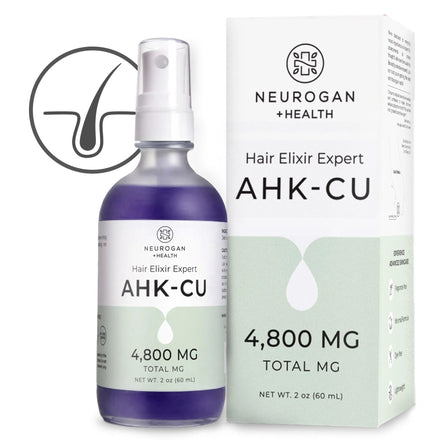
Saw palmetto is one of the most widely used botanical supplements for hair loss, with a mechanism that's reasonably well understood. AHK-Cu is a synthetic copper peptide that targets hair follicle biology from a completely different angle. They're not direct competitors — they work through different mechanisms, addressing different parts of the hair-loss puzzle.
what is AHK-Cu?
AHK-Cu (copper tripeptide-3) is a synthetic copper tripeptide designed to target hair follicle stimulation. It's composed of three amino acids — alanine, histidine, and lysine — bonded to a copper ion. It was first studied for hair growth in a 2007 paper from Seoul National University, which found statistically significant hair follicle elongation and dermal papilla cell proliferation in human follicle cultures treated with the compound [1].
AHK-Cu is a cosmetic ingredient applied topically as a scalp serum. It doesn't require a prescription and is not FDA-approved for hair loss.
What Is Saw Palmetto?
Saw palmetto is a botanical extract derived from the berry of the Serenoa repens palm tree. Its application to hair loss stems from the same mechanism as its use for prostate health: inhibiting 5-alpha reductase, the enzyme responsible for converting testosterone into DHT.
DHT, or dihydrotestosterone, is the main hormonal driver of androgenetic alopecia in both men and women, causing the progressive shrinking of hair follicles. Saw palmetto may slow down the body's DHT-producing enzyme, working similarly to finasteride but with a milder and less complete inhibitory effect [2]. Unlike finasteride, which reduces circulating DHT by approximately 70 percent, saw palmetto's effect is more modest and variable [3].
How AHK-Cu Works for Hair Loss
AHK-Cu directly stimulates dermal papilla cells — the specialized cells at the hair follicle base that control hair growth and cycling. When their populations decline or lose function, hair production weakens.
Dermal Papilla Cell Stimulation and Apoptosis Inhibition
In a lab study, Pyo and colleagues found that adding AHK-Cu to human hair-follicle cell cultures caused dermal papilla cells to divide significantly more, and observed about 43% less cleaved caspase-3 and about 78% less cleaved PARP — two proteins that indicate programmed cell death — both reductions large enough to be unlikely to be due to chance [1]. More dermal papilla cells surviving longer means the follicle's growth signal stays active for longer.
VEGF and Blood Flow
In lab tests, AHK-Cu helped skin cells make more VEGF (a protein that signals the body to grow new blood vessels around hair roots), potentially improving how well follicles are fed while they're actively growing [1].
Oxidative Stress Reduction
AHK-Cu upregulates superoxide dismutase (SOD), the antioxidant enzyme that neutralizes free radicals in scalp tissue. Oxidative stress amplifies local DHT production by upregulating 5-alpha reductase activity. AHK-Cu doesn't block DHT, but by reducing the oxidative conditions that drive excess local DHT production at the follicle, it may lower the effective DHT burden on follicle cells without any hormonal mechanism.
How Saw Palmetto Works for Hair Loss
Saw palmetto inhibits 5-alpha reductase, reducing the conversion of testosterone into DHT. Less DHT binding on dermal papilla cells means the miniaturization process slows. The active components responsible are the free fatty acids and plant sterols in the berry extract, particularly beta-sitosterol.
Saw palmetto also has anti-inflammatory properties that may support scalp health. The key distinction from finasteride is potency: finasteride selectively and strongly inhibits Type 2 5-alpha reductase, reducing circulating DHT by roughly 70 percent. Saw palmetto's inhibition is partial and non-selective, and varies considerably with extract quality and concentration.
clinical evidence Compared
AHK-Cu Evidence
AHK-Cu's clinical evidence base is small but specifically targeted at hair. The Pyo 2007 ex vivo study with 240 human follicles provided the foundational mechanistic data [1]. A Lee 2016 randomized study of 45 patients found 52 to 71 new hairs after six months of copper peptide treatment [4]. These are real findings, but the sample sizes are early-stage.
Saw Palmetto Evidence
In a 2012 randomized study of 100 men with mild to moderate androgenetic alopecia, 38% of those taking 320 mg of saw palmetto daily showed improved hair growth after 24 months, compared to 68% of men taking 1 mg finasteride [3]. Saw palmetto has more human clinical trial data for hair loss than AHK-Cu currently does.
Side Effects and Safety
AHK-Cu: No reported side effects at appropriate topical concentrations (1–3%). Applied to the scalp, it doesn't enter systemic circulation, meaning no hormonal effects or sexual side effects. Patch test before full scalp application is always a good idea.
Saw palmetto: Generally well-tolerated. The most commonly reported side effects are mild gastrointestinal complaints, most often when taken on an empty stomach. Because saw palmetto has mild anti-androgenic properties, there is theoretical potential for hormonal side effects, though these were not significantly elevated above placebo in randomized trials. Pregnant or breastfeeding individuals should avoid it.
Can You Use AHK-Cu and Saw Palmetto Together?
Yes, and the combination makes sense. They operate through different mechanisms with no known interaction between them.
Saw palmetto works on the hormonal side — it partially reduces DHT, which causes follicle miniaturization. AHK-Cu works on the cellular side — it stimulates the dermal papilla cells and growth pathways that DHT has been damaging. Together, they address two different parts of the same problem.
In a practical routine, oral saw palmetto (taken with food) handles the systemic DHT-reduction component, and a topical AHK-Cu scalp serum applied once or twice daily provides the cellular follicle support. For people who want a fully non-prescription, non-pharmaceutical approach that addresses both hormonal and cellular dimensions of pattern hair loss, combining saw palmetto and copper peptides is one of the more mechanistically complete natural strategies available.
Which Should You Choose?
Choose AHK-Cu if your goal is to support follicle cell health from the cellular level up, without any hormonal mechanism. It's particularly well-suited for people who want to address follicle biology directly, for age-related thinning, and for women (no established contraindications).
Choose saw palmetto if you want a botanical, non-prescription approach to reducing DHT-related follicle damage without pharmaceutical DHT blockers. It's best suited for mild to moderate androgenetic alopecia where the hormonal mechanism is the primary driver.
Use both if you're looking for a fully non-prescription protocol that covers both the hormonal and cellular dimensions of pattern hair loss. They don't duplicate each other's function.
Add prescription treatments if your hair loss is significant or progressing rapidly. Finasteride and minoxidil have substantially stronger clinical evidence, and starting with them under physician guidance is the more evidence-aligned path for moderate to severe androgenetic alopecia.
References
- Pyo, H. K., et al. (2007). The effect of tripeptide-copper complex on human hair growth in vitro. Archives of Pharmacal Research, 30(7), 834–839. https://pubmed.ncbi.nlm.nih.gov/17703734/
- Evron, E., et al. (2020). Natural hair supplement: friend or foe? Saw palmetto, a systematic review in alopecia. Skin Appendage Disorders, 6(6), 329–337. https://pmc.ncbi.nlm.nih.gov/articles/PMC7706486/
- Rossi, A., et al. (2012). Comparative effectiveness of finasteride vs Serenoa repens in male androgenetic alopecia: a two-year study. International Journal of Immunopathology and Pharmacology, 25(4), 1167–1173. https://pubmed.ncbi.nlm.nih.gov/23298508/
- Lee, W. J., et al. (2016). Efficacy of a complex of 5-aminolevulinic acid and glycyl-histidyl-lysine peptide on hair growth. Annals of Dermatology, 28(4), 438–443. https://pmc.ncbi.nlm.nih.gov/articles/PMC4969472/