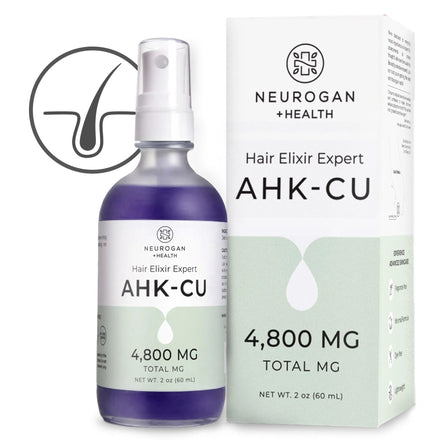
AHK-Cu and GHK-Cu are both copper peptides used in hair loss treatments, but they work through different mechanisms at different parts of the follicle and its surrounding tissue. Combining them at a 1:1 ratio is a formulation approach designed to address both the follicle cell layer and the scalp structural layer simultaneously.
Understanding why this ratio matters requires understanding what each peptide does and why those mechanisms are complementary rather than redundant.
What AHK-Cu Does for Hair (Copper Tripeptide-3)
AHK-Cu (L-Alanyl-L-Histidyl-L-Lysine copper) is a synthetic copper tripeptide developed specifically for hair follicle targeting. The key mechanisms: dermal papilla cell stimulation: The dermal papilla (DP) is the cluster of mesenchymal cells at the base of the follicle that control whether the follicle is in active growth (anagen) or regression (catagen). AHK-Cu stimulates DP cell proliferation in human follicle cultures, statistically significantly increasing both follicle elongation and cell count [1]. TGF-beta-1 suppression: TGF-beta-1 is a key signal that triggers catagen (regression phase). AHK-Cu reduces TGF-beta-1 in DP cells, effectively helping keep follicles in the growth phase longer. Anti-apoptotic effects: AHK-Cu reduces programmed cell death in follicle cells — approximately 43% reduction in caspase-3 and 78% reduction in PARP in cell studies. This matters particularly in androgenetic alopecia, where follicles undergoing miniaturization show elevated apoptosis. VEGF upregulation: Promotes new blood vessel formation in follicle-adjacent tissue.AHK-Cu acts most directly on the follicle's "control room" — the dermal papilla and its immediate cellular machinery.
What GHK-Cu Does for Hair (copper tripeptide-1)
GHK-Cu (Glycyl-L-Histidyl-L-Lysine copper) is naturally occurring in human plasma, first studied in 1973 by Dr. Loren Pickart [2]. Its mechanisms are broader and less follicle-specific: collagen synthesis: GHK-Cu upregulates collagen type 1, 3, and 4 in dermal fibroblasts and inhibits MMP-1 (collagenase), the enzyme that degrades collagen. The scalp's collagen matrix provides structural support to follicles. Anti-inflammatory: GHK-Cu reduces pro-inflammatory cytokines. Chronic scalp inflammation is associated with progressive androgenetic alopecia. VEGF: GHK-Cu upregulates VEGF in dermal fibroblasts, promoting new capillary formation that supports follicle nutrition. Antioxidant: Induces SOD (superoxide dismutase) and catalase. Oxidative stress in the scalp microenvironment accelerates follicle miniaturization. Gene regulation: Activates over 4,000 repair-related genes, many of which become underactive with age [3].GHK-Cu acts on the scalp environment surrounding the follicle — the tissue architecture, vascular supply, inflammation state, and oxidative conditions.
Why the Two Mechanisms Are Complementary, Not Redundant
| Mechanism | AHK-Cu | GHK-Cu |
|---|---|---|
| Dermal papilla cell proliferation | Yes (primary effect) | Indirect |
| TGF-beta-1 suppression | Yes | No |
| Anti-apoptotic (follicle cells) | Yes | Partial |
| VEGF upregulation | Yes | Yes |
| Collagen synthesis support | No | Yes (primary effect) |
| Anti-inflammatory | Indirect | Yes |
| Antioxidant protection | No | Yes (SOD/catalase) |
| Gene regulatory activation | No | Yes (4,000+ genes) |
| Acting on: | Follicle cell machinery | Scalp tissue environment |
AHK-Cu targets the cellular control layer — the decisions the dermal papilla makes about growth vs. regression, life vs. apoptosis. GHK-Cu targets the structural and environmental layer — the tissue that supports the follicle, the blood supply that feeds it, and the inflammatory and oxidative conditions it operates in.
Neither one covers the other's ground fully. This is why combining them in a formula is logically sound: each provides something the other doesn't.
Why 1:1 Specifically?
The 1:1 ratio is a balance decision. There is no published clinical trial comparing different AHK-Cu:GHK-Cu ratios to determine optimal dosing. The reasoning behind equal proportions is:- Both mechanisms are valuable for the hair loss context — neither should be subordinate
- Equal contribution ensures neither is present at a concentration too low to be effective
- It avoids biasing the formula toward one mechanism at the expense of the other
- It's a transparent formulation choice that can be stated on the label
A 3:1 AHK-Cu:GHK-Cu ratio would emphasize follicle stimulation but underserve scalp tissue support. A 1:3 ratio would emphasize scalp health but may not provide sufficient direct DP stimulation. The 1:1 is a considered split.
When Does the 1:1 Ratio Matter Most?
For age-related thinning: GHK-Cu's collagen and antioxidant effects become more relevant as scalp collagen declines with age and oxidative damage accumulates. A 1:1 formula ensures both tissue support and follicle stimulation are addressed. For early androgenetic alopecia: AHK-Cu's DP stimulation and TGF-beta-1 suppression are most valuable here. The GHK-Cu contribution addresses scalp inflammation, which is also a feature of early AGA progression. For combination with minoxidil: Minoxidil handles vasodilation. The 1:1 copper peptide formula covers DP stimulation (AHK-Cu) and structural support (GHK-Cu) — distinct from what minoxidil provides.How to Use a 1:1 AHK-Cu/GHK-Cu Formula
Apply daily (or twice daily) to a clean, dry scalp. Part hair into sections over the thinning or at-risk areas, apply 2-4 sprays per section (for spray format), and massage in. Leave on.The evaluation window is six months. Results are measured in months because the hair growth cycle is months long.
Frequently Asked Questions
Can I get the same effect by using separate AHK-Cu and GHK-Cu products?
Yes, if both products are used consistently and in compatible formulations. A single combined formula is more convenient and removes the timing question. Also eliminates the risk of purchasing one with insufficient active concentration.Is a 2:1 ratio of AHK-Cu better for hair than 1:1?
There's no published clinical data comparing these ratios. The 1:1 represents a balanced approach to covering both mechanisms. Whether more AHK-Cu produces better results is unknown.Does the 1:1 ratio matter for skin as well as hair?
GHK-Cu is more studied for skin applications (collagen, anti-aging). For pure skin use, a GHK-Cu dominant formula may be appropriate. For scalp and hair, the AHK-Cu contribution is more relevant.References
- Pyo, H. K., et al. (2007). The effect of tripeptide-copper complex on human hair growth in vitro. Archives of pharmacal research, 30(7), 834-839.
- Pickart, L., & Thaler, M. M. (1973). Tripeptide in human serum which prolongs survival of normal liver cells. Nature: New biology, 243(124), 85-87.
- Pickart, L., & Margolina, A. (2018). Regenerative and protective actions of the GHK-Cu peptide. International journal of molecular sciences, 19(7), 1987.