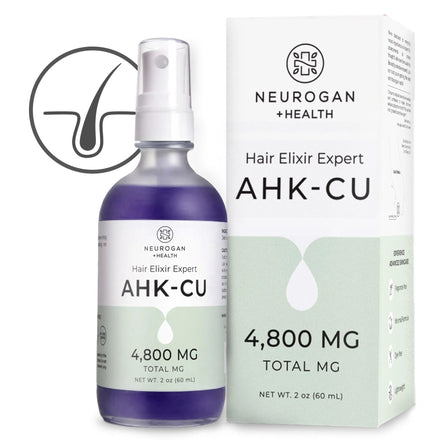
Graphic comparing GHK-Cu and AHK-Cu copper peptide hair serums, featuring two blue spray bottles.
Copper peptides have been circulating in the skin care conversation long enough that most people researching hair loss have at least seen the term.
But once you start looking at products, two names keep coming up: GHK-Cu and AHK-Cu. They're both copper peptides, and they're sometimes sold in the same formulation. So what's actually different about them?
The short answer is that they target different things.
GHK-Cu, also called Copper Tripeptide-1, is the older and more extensively studied of the two, with a research base spanning skin repair, wound healing, and broader tissue regeneration. AHK-Cu, or Copper Tripeptide-3, is a synthetic peptide specifically engineered with hair follicle stimulation in mind.
That distinction is key when you're trying to figure out which one belongs in your routine, or whether you need both. This article walks through what makes each peptide distinct, what the research says about each, and how to think about them practically.
What Is GHK-Cu?
GHK is a tripeptide with the sequence glycyl‑L‑histidyl‑L‑lysine (glycine–histidine–lysine) that forms a copper complex (GHK‑Cu).
It’s a naturally occurring tripeptide first isolated from human blood plasma by biochemist Dr. Loren Pickart in 1973 [1]. Its INCI name is Copper Tripeptide-1, and it's one of the most studied peptide compounds in cosmetic and regenerative research.
Multiple sources state that endogenous GHK (and its copper complex GHK‑Cu) is present in human plasma, saliva, and urine, and that its concentration declines with age [1].
For example, one widely cited summary notes plasma GHK‑Cu levels of about 200 ng/mL at age 20, dropping to about 80 ng/mL by age 60, indicating a substantial age‑related decline [1].
For hair specifically, GHK-Cu has been studied in the context of follicle size and the hair growth cycle.
Topical copper peptides like GHK‑Cu may help make hair follicles larger and support hair growth, based on lab and early human studies. However, there are still very few high‑quality human studies that directly compare copper peptides to minoxidil in the same trial [2].
GHK-Cu's broader role in skin and tissue biology is better established than its hair-specific effects. It's earned its place in the ingredient conversation through decades of peer-reviewed research, even if hair growth is only one piece of what it appears to do.
What Is AHK-Cu?
AHK-Cu stands for alanine-histidine-lysine copper. Its INCI name is Copper Tripeptide-3, and its CAS number is 682809-81-0. Unlike GHK-Cu, AHK-Cu does not occur naturally in the body. It was synthetically engineered, with its amino acid sequence specifically designed to enhance its affinity for hair follicle tissue.
The structural difference from GHK-Cu is a single amino acid swap: glycine is replaced by alanine at the first position of the chain.
That one substitution changes how the peptide interacts with cellular receptors. The theory is that it shifts the peptide's biological activity more narrowly toward hair-follicle stimulation, rather than the broader tissue-repair profile of GHK-Cu.
AHK‑Cu was evaluated in peer‑reviewed hair research in a 2007 in vitro study by Pyo and colleagues at Seoul National University, which examined its effects on human hair follicles and dermal papilla cells [3].
That study evaluated AHK‑Cu in cultured dermal papilla cells, the specialized cells at the base of hair follicles that act as a functional control center for hair growth. The researchers found that AHK‑Cu enhanced dermal papilla cell proliferation and influenced apoptosis‑related markers, suggesting reduced cell death signaling in treated samples.
The Single Amino Acid Swap That Changes Everything
Both GHK-Cu and AHK-Cu share two of their three amino acids: histidine and lysine. The difference is the first amino acid in the chain. GHK-Cu starts with glycine; AHK-Cu starts with alanine.
In chemistry, that kind of swap is called a structural analog. Think of it the way a locksmith might rework a key: same basic shape, small change at the tip, different doors it opens well. The copper ion at the center of both peptides is the same. What changes is how each peptide interacts with cell surface receptors and signaling pathways.
Glycine is the smallest amino acid, and its presence in GHK-Cu is thought to contribute to that peptide's broad tissue affinity. Alanine is slightly larger and more hydrophobic, which researchers theorize may improve how AHK-Cu binds to receptors more concentrated in follicular tissue.
This is a plausible hypothesis grounded in peptide chemistry, but it's worth being clear that the evidence for AHK-Cu's superior follicle selectivity compared to GHK-Cu is not yet established in direct head-to-head human clinical trials. Most of what supports this distinction comes from cell studies and the original Pyo 2007 research.
How Each Peptide Appears to Affect Hair Follicles
GHK-Cu's most studied hair-related effect is on follicle size and the hair growth cycle. The copper it delivers appears to support the activity of enzymes involved in maintaining follicle tissue, including lysyl oxidase, which plays a role in structural protein cross-linking in the follicle.
Preclinical and mechanistic research suggests that GHK‑Cu may help keep hair follicles in the anagen (active growth) phase longer, in part by influencing growth‑related signaling pathways in follicle cells [1].
Because GHK-Cu has broader tissue effects, some researchers have also suggested it may support scalp skin health as a foundation for follicle function, though this is more inference than established finding.
AHK-Cu and Hair Follicle Biology
AHK-Cu's proposed mechanisms are more specifically targeted to follicle cell activity. The Pyo 2007 study found that AHK-Cu treatment was associated with a 42.7% reduction in caspase-3 activity and a 77.5% reduction in PARP cleavage in cultured dermal papilla cells [3]. Both caspase-3 and PARP are markers of apoptosis, or programmed cell death. Reducing their activity suggests the peptide may help keep follicle cells alive and functional longer.
AHK-Cu has also been associated in cell studies with upregulation of VEGF, or vascular endothelial growth factor. VEGF is a signaling protein that stimulates the formation of new blood vessels, which matters for follicle health because active follicles are metabolically demanding and need good blood flow to receive nutrients.
Some laboratory research suggests that copper peptides like AHK‑Cu may help calm down certain ‘stop‑growth’ signals in hair follicles, including those involving TGF‑beta‑1. TGF‑beta‑1 is a signaling protein that tells hair follicles to leave the active growth (anagen) phase and move into the regression phase. If AHK‑Cu reduces this signal in follicle cells, it could in theory help hair stay in the growth phase for longer, although this has not yet been confirmed in large human studies [4].
Copper peptides such as GHK‑Cu show antioxidant effects in skin models, including SOD‑like activity and support of endogenous antioxidant defenses, and AHK‑Cu is often assumed to act similarly.
Oxidative stress is elevated in androgenetic alopecia and interacts with dihydrotestosterone (DHT)–driven signals like TGF‑β1 to push follicles out of growth and toward miniaturization. By lowering oxidative stress around follicles, copper peptides could theoretically offer some indirect protection against this miniaturization process, although that mechanistic chain is more speculative than current direct evidence proves.
GHK-Cu vs AHK-Cu: A Side-by-Side Look
Here's how the two peptides compare across the factors most relevant to hair applications.
| Factor | GHK-Cu (Copper Tripeptide-1) | AHK-Cu (Copper Tripeptide-3) |
|---|---|---|
| Origin | Naturally occurring in human plasma | Synthetically engineered |
| First isolated | 1973, by Dr. Loren Pickart | 2007 hair research (Pyo et al.) |
| INCI name | Copper Tripeptide-1 | Copper Tripeptide-3 |
| Amino acids | Glycine-Histidine-Lysine | Alanine-Histidine-Lysine |
| Primary research focus | Skin repair, wound healing, hair | Hair follicle stimulation |
| Research volume | Larger body of research | Smaller, more targeted studies |
| Proposed hair mechanism | Follicle size, growth cycle support | Dermal papilla cell survival, VEGF, TGF-beta-1, anagen extension |
| Human clinical trials | Small; one notable vs. minoxidil | Limited; mostly cell studies |
| Common use in formulations | Skin serums, scalp treatments | Scalp serums, hair peptide blends |
Which Types of Hair Loss Are These Targeting?
Both peptides are most relevant to androgenetic alopecia, the form of hair loss caused by genetic sensitivity to DHT (dihydrotestosterone) that progressively miniaturizes hair follicles over time. Miniaturization means the follicle shrinks with each growth cycle, producing progressively finer and shorter hairs until the follicle becomes dormant.
Neither GHK-Cu nor AHK-Cu blocks DHT.
They don't work on the hormonal pathway the way finasteride or dutasteride do. Their proposed value is upstream and cellular: supporting follicle cell health, blood supply, and growth cycle duration in a way that may slow the miniaturization process or support the follicle's ability to remain active.
There's also some interest in copper peptides for diffuse thinning not driven by androgenetic alopecia, including stress-related shedding (telogen effluvium) and thinning related to scalp inflammation. The anti-inflammatory and antioxidant properties of copper peptides are relevant here, though this is a less studied application.
If you're seeing pattern hair loss (recession at the temples, thinning at the crown), copper peptides are an interesting complementary ingredient. They're not a replacement for interventions with more clinical evidence behind them.
How Copper Peptides Fit Alongside Other Hair Loss Approaches
Minoxidil works primarily by widening blood vessels in the scalp, which increases blood flow to follicles and may extend the anagen phase. It has decades of clinical data and regulatory approval. Finasteride works by blocking the conversion of testosterone to DHT, which slows the hormonal driver of follicle miniaturization in men. Both have meaningful side effect profiles that some users want to avoid.
Copper peptides work differently.
Their mechanism is follicle nourishment and cellular support rather than vasodilation or hormonal suppression. They don't carry the systemic hormonal risk associated with finasteride, and they don't trigger the initial shedding phase that some minoxidil users experience when they start treatment.
That doesn't make them equivalent alternatives.
The clinical evidence for copper peptides is considerably thinner than what exists for minoxidil or finasteride. But for someone building a multi-layered approach to hair health, or someone who has contraindications for hormone-affecting compounds, topical copper peptides represent a category worth understanding.
Some practitioners and researchers have shown interest in combining copper peptides with microneedling, which creates micro-channels in the scalp and may enhance peptide penetration into the dermis where follicle cells are located. This pairing is increasingly common in clinical practice but hasn't yet been studied rigorously enough to draw firm conclusions.
How to Use AHK-Cu and GHK-Cu for Hair
Both peptides are used almost exclusively as topical applications in hair care formulations. The general approach is similar for each.
Scalp serums are the most effective delivery format because they're designed to stay on the scalp rather than be rinsed off.
Longer contact time gives the peptides more opportunity to interact with follicle tissue. Shampoos and conditioners may contain copper peptides, but the brief contact time during washing limits how much can be absorbed.
A realistic timeline for any follicle-targeting ingredient is three to six months of consistent use before meaningful changes in hair density or thickness would be visible, if they're going to appear at all. Hair cycling is slow. Anyone promising visible results in weeks is overstating what the biology supports.
Below is a general overview of application approaches based on how these peptides tend to appear in formulations.
| Format | Typical Application | Notes |
|---|---|---|
| Leave-on scalp serum | Once or twice daily, applied to scalp | Best delivery format for penetration |
| Peptide blend serum (AHK + GHK) | Once daily, post-wash | Common combined approach |
| Microneedling prep/post | Applied before or after needling session | May improve dermal absorption; consult a professional |
| Scalp treatment mask | Weekly, left on 20–30 min | Lower frequency, may suit sensitive scalps |
| Shampoo/conditioner | As part of normal washing routine | Limited contact time; lower priority format |
Safety Profile: What to Know
Copper peptides are generally well-tolerated topically. No significant hormonal side effects have been reported in the literature, which distinguishes them from finasteride-based approaches. No shedding phase has been documented with copper peptide use, unlike the temporary shedding some minoxidil users experience in the first weeks of treatment.
The natural blue-green tint that some copper peptide serums have is from the copper ion itself, not a dye or artificial colorant. It's a reasonable indicator that the peptide complex is present in the formulation, though color alone isn't a quality measure.
At high concentrations, copper can potentially become pro-oxidant rather than antioxidant.
Well-formulated products are designed to avoid this range. If you're using a scalp serum, following the manufacturer's usage instructions is the sensible approach rather than assuming more product means faster results.
As with any topical active, patch testing before full scalp application is a reasonable step, particularly for people with sensitive skin or scalp conditions.
So Which One Should You Use?
If you're primarily interested in hair follicle support and are comfortable with a newer, more narrowly studied compound, AHK-Cu has the more targeted research rationale for hair applications. The Pyo 2007 data and the subsequent Lee 2016 findings point specifically toward follicle cell survival and growth cycle mechanisms.
If you want the compound with a longer research track record and broader biological activity, including some hair-related findings, GHK-Cu is the more established choice. Its skin and tissue repair research also extends benefits beyond the scalp if you're using it in a broader skincare context.
Many formulations include both, and there's a reasonable argument that they may complement each other: GHK-Cu for its broader tissue support and documented follicle size effects, AHK-Cu for its more specific dermal papilla cell targeting.
Whether combining them adds meaningful benefit over either alone hasn't been tested directly, so this remains a plausible hypothesis rather than an established finding.
Either way, copper peptides work best as part of a fuller approach to scalp health rather than as a standalone solution. Nutrition, scalp circulation, and stress management all contribute to the environment follicles grow in. Copper peptides are a reasonable thing to add to that picture, not a replacement for it.
References
- Pickart, L., Vasquez-Soltero, J. M., & Margolina, A. (2015). GHK peptide as a natural modulator of multiple cellular pathways in skin regeneration. BioMed Research International, 2015(1), 648108.
- Hairgenetix. (2026, March 4). GHK peptide hair growth clinical trial (2016). Hairgenetix.
- Pyo, H. K., Yoo, H. G., Won, C. H., Lee, S. H., Kang, Y. J., Eun, H. C., ... & Kim, K. H. (2007). The effect of tripeptide-copper complex on human hair growth in vitro. Archives of Pharmacal Research, 30(7), 834–839.
- Pickart, L., & Margolina, A. (2018). Regenerative and protective actions of the GHK-Cu peptide in the light of the new gene data. International Journal of Molecular Sciences, 19(7), 1987.